
ChatGPT Ads went from one market to forty in six months
| Feb 2026 | 1 |
|---|---|
| Mar 2026 | 4 |
| Aug 11 2026 | 9 |
| Aug 25 2026 | 40 |
Your buyer is probably on a plan that never shows an ad
Start with who can see the card. Ads in ChatGPT show to logged-in adults on the Free tier and on Go, the $8 a month plan with higher usage limits and unlimited everyday text. Plus, Pro, Business, Enterprise and Edu users see none. Anyone the platform identifies or predicts as under 18 sees none. Temporary Chats carry no ads, logged-out sessions carry no ads, the Atlas browser carries none during the test, image-generation conversations carry none, and a Free user who refuses ads can take a reduced free plan with fewer messages a day and no image tools.
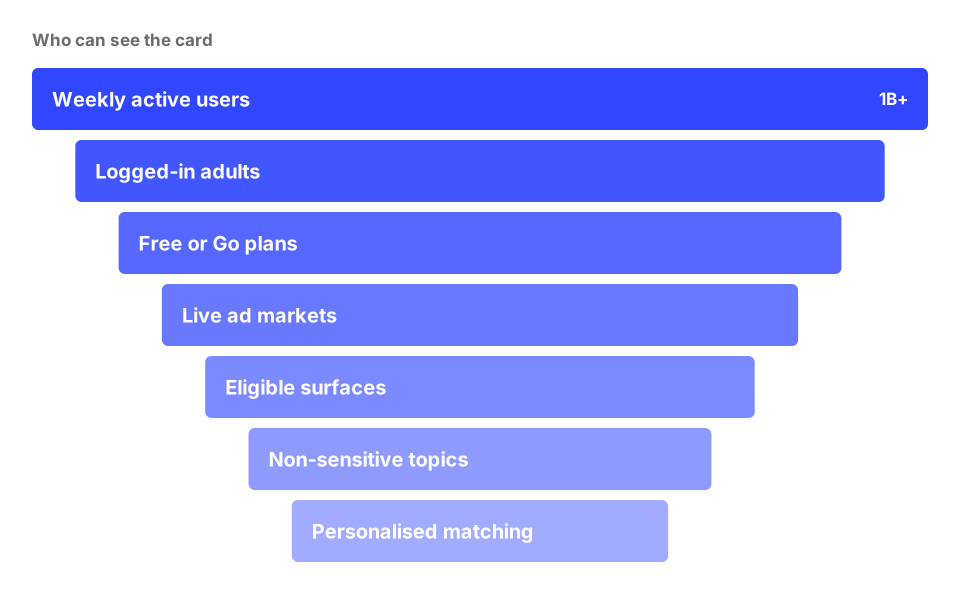
Then the topic exclusions. No card runs near personal health, mental health or politics, and political advertising is off the platform entirely. Medical, legal and financial advice contexts were categorically blocked until April 2026; they are now restricted categories that need advertiser verification, and US legal services became eligible in August. In the EEA and Switzerland personalised ads are unavailable, so a European card is matched on the live conversation alone, with no past chats and no past ad interactions in the score.
Read all of that as an inventory statement. The pool is the adult who has chosen to pay $0 or $8 a month for the product, who is logged in, who has history switched on, and who is talking about something commercial enough to clear the sensitivity filter. A billion weekly users is the headline; the addressable slice for a given advertiser is what survives those six cuts, and for a B2B account it is the Free users inside the companies you sell to.
The category it hurts most is the one with the most expensive clicks. A B2B account whose decision-maker runs ChatGPT through a Business or Enterprise seat is bidding into inventory that is structurally empty of that person. Whoever evaluates vendors on a company plan never sees the card. The people who do see it are the Free users at the same company, who may hold the job title you want and almost never hold the budget. That is settled before the first bid is set, and at $15 to $20 a click for B2B intent it is an expensive thing to discover live.
So the audit starts in your own data. Every account we take on here, we pull plan tier before anything else: the onboarding survey field that asks which AI tools the prospect uses, the user research notes, the sales call recordings where someone mentions the company account. If the answers cluster on Business and Enterprise, the test budget goes to a channel where the customer exists. If they cluster on Free and Go, which they do for consumer, prosumer, small business and most home services, everything below applies and the inventory is worth the work.
Do that check in a week. It costs a survey field and an afternoon of reading transcripts, and it is cheaper than the $25 a day the US standard campaign minimum will spend finding out the hard way.
Fifty million pay for ChatGPT and the $8 ones still see the card
More than a billion people open ChatGPT every week and at least fifty million pay. The paying slice splits two ways. Plus, Pro, Business and Enterprise never see a card. Go, the $8 plan, does, which makes it the one paid tier a bid can reach and the one where the user has already put a card on file inside the product. Nine million of the paying users are on business plans, which is where the person who evaluates vendors on a company seat sits, and no setting in the current structure moves them into the inventory.
One ad group per prompt the buyer actually types
The match works like this. With personalisation on, the platform scores an ad against the topic of the live conversation, the user's past chats and their past interactions with ads. Context hints are free text at ad group level; they steer the match and guarantee no placement. Relevance is read from four inputs, the hints, the landing page, the title and the copy, and the auction is relevance-weighted and second-price, so a more relevant card beats a higher bid and pays the price set by the card beneath it. The card itself is advertiser name, favicon, one title, one line of copy, a landing page and a single image, served as a labelled sponsored unit below an answer the model generated on its own.
Ported search accounts die on the next step. A Google keyword is two or three words with the intent inferred from them. A ChatGPT prompt arrives with the intent spelled out: the budget, the stack it has to fit, the deadline, the thing that went wrong last time. So the unit of work is the prompt, and the account structure follows it: one ad group per prompt shape, hints written as the sentences a prospect types, copy that answers that one ask. The category term the RSA was built on is already covered by the answer above the card, and the card has one title and one line of copy to add to it.
We mine the prompts from three places: sales call transcripts, support tickets and on-site search logs. Each is tagged with the problem behind it, the tags cluster into groups of a dozen or so, and each cluster becomes an ad group with its own hints, its own card and its own landing page. The library is one sheet, a column for the hint text and a column for the page it points to, and the same sheet feeds the answer-engine work later. Version one is forty tagged prompts, forty pages, forty ad groups.
On the image asset, a card with a person's face in it outpulls a logo by an order of magnitude, and the asset that wins most often is a founder's headshot shot on a phone. Hints have a length the matcher can read. A few hundred words delivers; a thousand strangles delivery to almost nothing, because the matcher is reading for one conversation shape and you have described twelve. Age and gender descriptions come out entirely, since there is no demographic targeting behind them and they only dilute the topic signal. Cut to a few hundred words, drop the demographic adjectives, and a stalled campaign reaches its full $25 a day.
The r/PPC thread that first benchmarked the beta put its winning ad group at two to three times Google Display and well below Search, and that is the frame to keep. Published card CTRs cluster between 0.6% and 0.94%, so a working card posts a display-shaped number, and anyone holding it to the 2% a search campaign posts will kill a healthy account. A CTR under about 0.3% is a hints problem before it is a creative problem: rewrite the hints, cut the word count, and rerun for seven days before touching the copy.
Send the qualified lead back, and read the result in the CRM
Three objectives, chosen per campaign with the bid set at ad group level, and the choice between them is most of the account.
| Objective | Billing | Bid | What to know |
|---|---|---|---|
| Views | CPM | Default max $60 | Reach buy; CPMs have drifted from around $60 at launch toward around $25 |
| Clicks | Valid clicks only | Recommended start $3 to $5 | Charged only on a click outcome |
| Conversions | Click or impression | Bid Cap, conversion-oriented | One standard event per campaign, fixed at creation, no custom events; Bid Cap is the bid the campaign competes with in the click auction and the achieved CPA is a separate number |
CPC and outcome-optimised bidding are now the majority of campaigns, and the starting bid is a fiction for anyone selling to businesses: real B2B intent clears in the mid to high teens per click, which is roughly what the same advertisers pay for the equivalent search click. Budget pacing is a seven-day rolling average that can spend twice the daily figure in a day and seven times it across a week, so a $700 week is entered as $100 a day, and a strong Tuesday can take $200 of it.
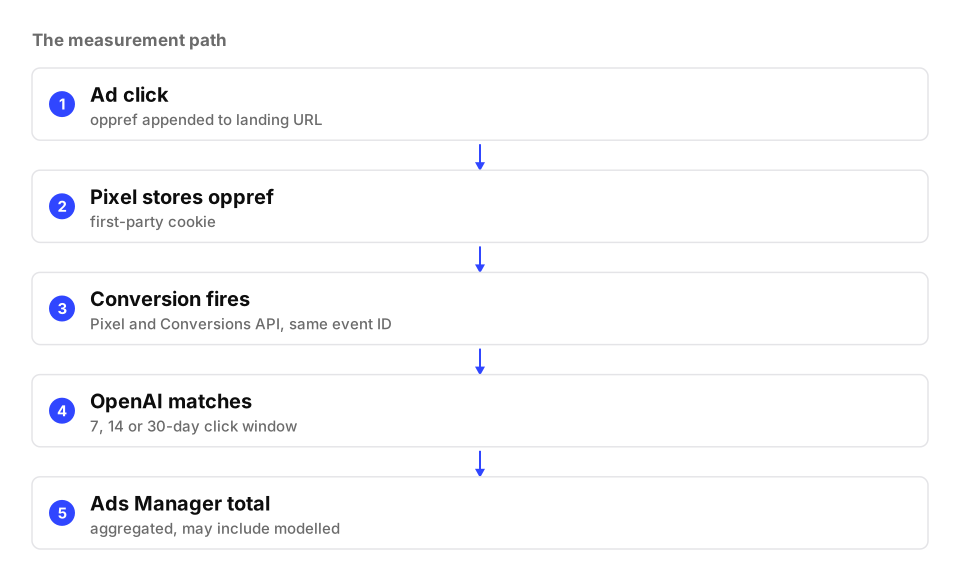
The plumbing. A click appends oppref to your landing URL; the OpenAI Pixel reads it into a first-party cookie. Preserve it through every redirect and page change, send it with server-side events, and run Pixel and Conversions API together using the same event ID so the platform deduplicates. Advanced matching sends SHA-256 hashed contact fields; automatic advanced matching has been on for all web pixels since 17 August. Amounts go in minor units, so 4999 is $49.99. Attribution windows are 7, 14 or 30 days click-through with 0 or 1 day view-through, batches take up to 1,000 events, and the rate limit is around 600 requests a minute per endpoint.
Which event. The qualified lead or the first order. The model optimises to whatever you send, and a click or a form view teaches it to find people who click and fill forms. HubSpot is the first CRM partner and Shopify the first ecommerce partner, with the Shopify app going international on 23 September, so the lead can land in the pipeline with its source intact. The join that breaks is the hashed email on your form against the CRM contact when the prospect uses a different address; dedupe on a lead ID you issue, and send that ID in the Conversions API payload alongside the hashed email.
Reporting lags are structural. Impressions and CTR refresh roughly every 15 minutes, spend runs 7 to 8 hours behind, conversions 24 to 48 hours. Platform clicks will exceed analytics sessions, which is expected and is why the join is oppref in your own tables with UTMs as the fallback.
Then the holdout. US targeting supports state, DMA and ZIP since 3 June, so hold out matched DMAs for six to eight weeks and measure lifted pipeline in the CRM, because Ads Manager totals may include modelled conversions. One advertiser's 3x ROAS over 28 days and a partner's 80% new-customer figure are a single account, a single month and somebody else's traffic definition. Plan on the lift the holdout shows, in qualified leads, over the six to eight weeks.
A Sponsored Agent is a knowledge base with a sales target
What exists. Since 16 September, Sponsored Agents have been in test with select US advertisers. A user who has seen a relevant card can choose to open a clearly labelled conversation with the business's own agent, kept separate from ChatGPT's answers and from the thread they were in. Wayfair and Angi are the first named partners, Angi taking a leaky-faucet conversation through to a booked contractor without the user leaving the app.
Advertisers never see ChatGPT conversations and get aggregated reporting only. The agent's side of the label is the only transcript you will ever hold, so every turn gets logged, tagged and read weekly: it is the one place the channel shows you the exact words a prospect typed, budget figure included.
Underneath it is one structured knowledge base. Product marketing owns it, sales reviews it weekly against what they heard on calls, and a QA gate blocks any statement the agent makes that the base does not carry.
| Component | Owner | Review cadence | Gate |
|---|---|---|---|
| Pricing logic | Product marketing | Every pricing change, same day | Agent cannot quote a figure the pricing sheet does not carry |
| Proof points | Product marketing | Monthly | Every claim traces to a published case or figure |
| Objection handling | Sales | Weekly, against the week's calls | New objection heard twice gets an entry |
| Customer language | Sales and support | Weekly | Every phrase traces to a transcript |
Cost to keep it honest: a product marketer's day a week and a sales reviewer's hour, every week, for as long as the agent runs. The metric is the ratio of prompts answered to prompts escalated to a human, read weekly. The failure mode is the pricing page changing while the knowledge base does not. From that day the agent quotes the old price, fluently, to someone who arrived from a neutral answer they can compare you against, with a deadline, in a conversation you never see, under your own brand's label. A homepage chatbot irritates a browser; this one burns a prospect at the moment of decision, which is why the pricing row is reviewed the same day a price changes.
So the order matters. The agent comes after the card has found a prompt that converts and after the prompt library is mature enough to answer most of what arrives. An account that cannot yet say which prompt converts has no material to build the agent from, and the first version of the knowledge base is the same forty prompts and forty pages the ad groups were built on.
The organic answer beside your card is the competitor you are bidding against
Ads do not influence what the model says, and the card is visually separated below the answer. For an advertiser that means your sponsored unit can sit directly beneath a recommendation that names someone else, and the person reads the recommendation first. The match misses as well: across 50,000 commercial prompts in twenty niches, roughly one ad in seven landed beside a conversation it had no connection to, and in news-adjacent categories the miss rate climbed above half.
So answer-engine presence and the paid card are one workstream, fed by the same prompt library the ad groups were built from, with three owners.
| Surface | Owner | Built from | Measured by |
|---|---|---|---|
| The organic answer | SEO and content | Pages written to the mined prompts, structured so the model cites them | Share of category prompts where the brand is named or cited |
| The sponsored card | Paid | One ad group per prompt the prospect typed, hints in customer language | Qualified leads in the CRM against a DMA holdout |
| The Sponsored Agent | Product marketing | The maintained knowledge base | Answered-to-escalated ratio |
The brand that appears in the model's answer and in the card below it has two surfaces corroborating each other. The brand that appears only in the card has paid to sit next to its rival, at $3 to $5 a click on the starting bid and the mid teens on real B2B intent.
Run the prompt library through the platform, with personalisation off and with it on, and record which pages the model cites for each prompt in your category. The gap between those cited pages and the pages you own is the content brief, and it is usually a comparison page, a pricing explainer and a how-to that nobody on the content team thought was commercial. Those pages get a brand named in the answer, and they take a quarter to build and another to be picked up.
The floor fell from $250,000 to nothing in three months
| Feb 2026 | 250000$ |
|---|---|
| Apr 2026 | 50000$ |
| May 2026 | 0$ |
Keep it to a test budget and leave the RSAs where they are
Start with who should stay away. Impulse and low-consideration categories win on fame and distribution, and nobody opens a chat to ask which crisps to buy. Rebuilding that brand's account around a conversation that does not happen is a quarter of a few thousand dollars a month against a prompt nobody types.
The ceiling is set from outside too. Claude will remain ad-free, and every third-party interaction in it starts with the user. Gemini holds roughly a quarter of assistant usage and Claude single digits, so the share of assistant conversations any sponsored card can reach is one platform's free tier: the Free and Go users of ChatGPT.
A meaningful test is a few thousand dollars a month for a quarter, with a 60 to 90 day read before any conclusion, because conversions post 24 to 48 hours late and delivery comes in pulses of about three days on and one or two off. Inside that budget, the things I would refuse to do:
- Port the Google RSAs. The card has one title and one line of copy, and the headline that won on Google was built for a two-word query.
- Buy Reach at the default $60 CPM for a brand that is not already on the shelf.
- Send the click or the form view as the conversion event.
- Switch on a Sponsored Agent before a card has found a prompt that converts.
- Read Ads Manager spend in the first eight hours and change bids on it.
- Describe an audience in the hints that has no targeting behind it.
Each of those is an account behaving as though it were a search campaign, and a search campaign here spends $3 to $5 a click to sit ignored beneath a neutral answer.
By the end of 2027, B2B spend on this platform is still a sliver of the total. The people who sign B2B contracts are on the plans with no ads, enterprise revenue is already over 40% of the company's total, and no setting in the current structure moves a company-seat user into the inventory. The one thing that would change my mind is OpenAI selling an ad unit into Business plans, and I do not expect that unit to exist before the end of 2027. The ad business reached a billion dollars annualised in under 200 days on consumers, small business and home services, and the categories converting in the r/PPC write-ups are home services, car rental, international real estate and personal injury law, with a SaaS startup and dental on the list that did not.
If you do test, own it properly. Paid owns the card, product marketing owns the prompt library and the agent's knowledge base, and the SEO team owns the organic answer. That is three teams for one placement, and it is the real reason most accounts will run this as search anyway. The ones that run it as a conversation will be the ones whose brand is in the answer and in the card below it, at a few thousand dollars a month, for the Free and Go user who is the only person on the other side of the label.