
The playbook everyone copied sold twice in five weeks
Airtable went to Bending Spoons at $1.285 billion in enterprise value. Five weeks later, Miro went to the same buyer at $1.355 billion. Both all-cash, both under 3x ARR, both to a company that has never sold a material business in more than a decade of doing this. Miro was worth $17.5 billion in late 2021 and Airtable $11.7 billion that December.
The finance is two sentences and a denominator. The two balance sheets held about $1.4 billion in cash between them against roughly $4 billion of combined equity value, and Miro alone carried about $435 million in net cash against an implied equity value of $1.79 billion, a quarter of the cheque handed straight back on day one. Miro is profitable at roughly $600 million of ARR.
That $600 million sits on 100 million total users and nearly 4 million paying ones, across more than 250,000 organisations, with 90% of revenue from business and enterprise and more than 750 accounts over $100,000 a year. The free tier feeding the sales funnel, the sharing loop putting a board in front of people who never chose the product, the template library doing the work of demand gen, fifteen years of being the noun people use for the category: all of it traded at 2.3x revenue.
The repricing reached the option pool as well. A senior Airtable engineer who joined in early 2021 held a grant worth roughly $5.4 million at the December 2021 Series F, and about $1 million when Bending Spoons closed.
The lazy read is that the market has repudiated product-led growth. OpenView, the firm that coined the term and published the benchmark decks every operator in this category anchored their free-to-paid targets to, stopped making new investments at the end of 2023, and the doctrine carried on without it in every board pack since. What gets paid for now is the share of ARR growth that arrives as a new logo, and at Miro that was about $35 million last year.
How much of the price was their own money
The sellers funded roughly a third of their own sale. Two more terms worth carrying into your next diligence conversation: it is all cash, and certain Miro shareholders agreed to put $295 million of their proceeds straight back into newly issued Bending Spoons stock, about 16% of the equity value crossing the table and turning around. The people closest to the asset chose the buyer's paper over Miro's.
What the buyer refused to pay for
Start with the number a board would ask for first. About $600 million of ARR across nearly 4 million paying users is $150 per paying user per year, call it $12.50 a month. That is the blended realised price of a category-defining collaboration product after fifteen years of trading. And 250,000 organisations against 4 million paying users works out at roughly sixteen paid seats per organisation, a tool that sold in teams, over and over, and crossed into departmental money 750 times.
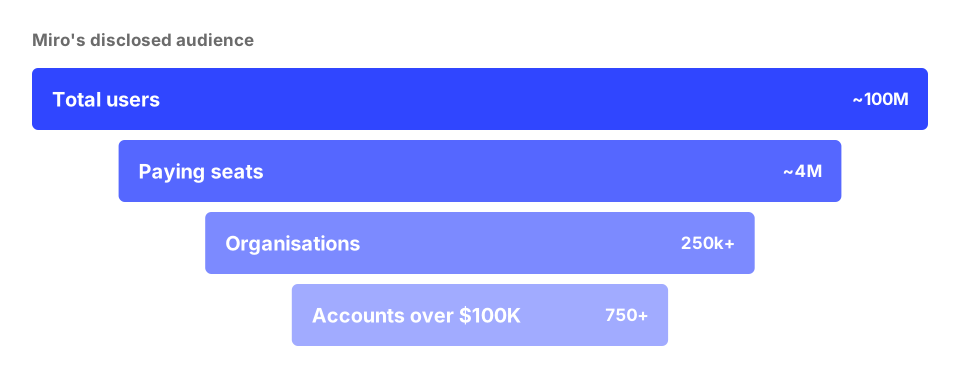
Now the denominator nobody wants to work. Around 100 million registered users against nearly 4 million paying is about 4% conversion, which leaves 96 million accounts contributing nothing directly. Run the multiple: 3x on $600 million is $1.8 billion, already more than the $1.355 billion enterprise value. The paying base alone covers the whole cheque, and the 96 million free accounts came in at a discount, because they consume storage, sync and support.
So here is the expression I would put in my own model. A free account is worth keeping if its annual serving cost sits below its annual conversion yield, and on a static read that yield is $600 million divided by 100 million registered users. Six dollars a year, per account, to cover hosting, emailing, prompting and re-engaging before the tier stops paying for itself, and most free tiers I have audited do not clear it once the lifecycle headcount is loaded in.
Nearly 90% of revenue from business and enterprise is about $540 million; the 750 accounts above $100K account for at least $75 million, roughly an eighth. The self-serve ladder built a very large mid-market and stopped at 750 departmental accounts.
The market stopped paying for mindshare
| ZoomInfo | 1% |
|---|---|
| Miro | 5.6% |
| Asana | 11% |
| HubSpot | 20.5% |
| Monday.com | 27% |
The precondition that quietly expired
A free tier attached to a sharing loop is a bet on a population. Every board link sent to a colleague who did not have an account was free distribution, and it compounded for exactly as long as there were teams left who had never seen the product. Miro is now inside more than 250,000 organisations.
You can watch the good years in the shape: 5 million users to about 30 million in two years to 2022, paying customers up 550%, while every meeting in the world moved onto a screen.
The loop did not break. It ran out of strangers.
Once you are in a quarter of a million organisations, the next seat is approved by procurement, in a renewal cycle, against a licence count somebody in finance is already trying to trim. That is a sales motion with a cycle measured in quarters, owned by a different team, and it shows up as 5.6% year-on-year growth on about $665 million of ARR: roughly $35 million of new ARR in a year, spread across 4 million paying users.
So here is the Monday test, and it takes an afternoon with your revenue table. Split last year's ARR delta three ways.
If new-logo is under a fifth of the total, under about $7 million of that $35 million in this case, you are running a renewal book with a marketing team attached to it, and your acquisition spend is buying expansion you would have got anyway. Neither company publishes that split. A buyer paying under 3x ARR for a product with 90% of revenue from business and enterprise accounts has priced exactly that shape.
- New-logo ARR: revenue from organisations that were not customers twelve months ago.
- Seat expansion: more licences inside accounts you already had, net of contraction.
- Price and mix: list increases, plan upgrades and discount roll-off on the existing base.
Same ARR, one eighth of the price
Run the division yourself: $1.355bn of enterprise value against roughly $600m of ARR is about 2.3x. Airtable went at 2.7x. Notion, at the same revenue scale, carries roughly 18x, and ClickUp about 13x on a third of the ARR. Nobody is paying for the hundred million registered users or the 250,000 organisations. They are paying for whether next year's revenue arrives from people who have not bought yet.
| Miro | 2.3X |
|---|---|
| Airtable | 2.7X |
| ClickUp | 13X |
| Notion | 18X |
What the new owner does to a marketing budget
The pattern is on the record and it is not subtle. Evernote, bought for $200m in 2023, most of the US and Chile staff cut, list price moved from about $100 a year to $249. WeTransfer, roughly 75% of staff gone within weeks of the July 2024 close. Of the 1,830 employees inherited from the AOL, Eventbrite and Vimeo deals, a few hundred are expected to still be there at the end of 2026, against $78.6m of reorganisation expense booked in 2025, about $43,000 a head to remove them.
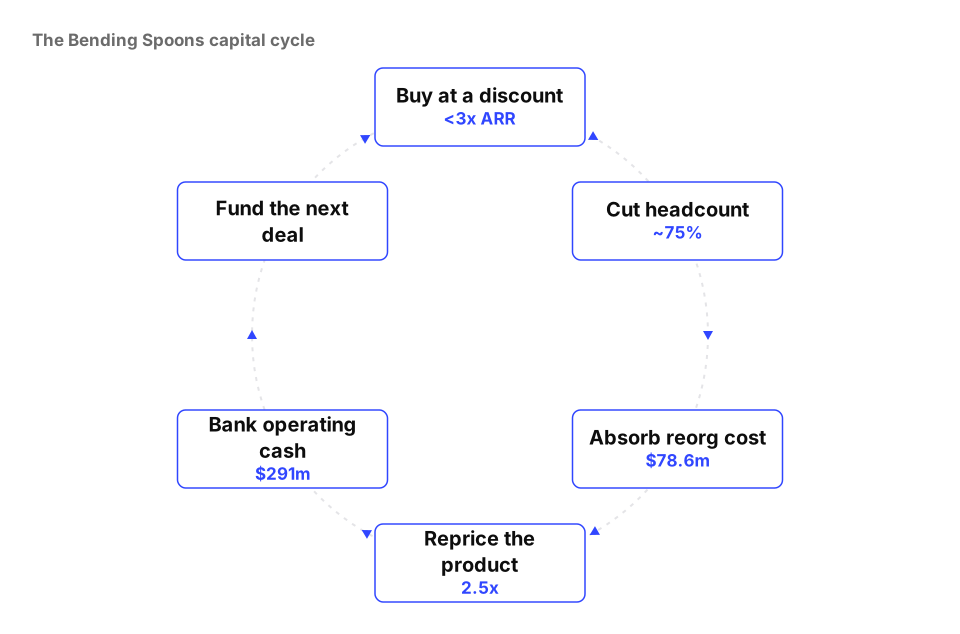
The Evernote price move is a growth decision. Going from $100 to $249 means you can lose 60% of your paying base and hold revenue flat: 1 divided by 2.49 is 0.40, so four in ten renewing at the new price gets you back to level. That arithmetic is the entire marketing plan. There is no acquisition target it needs to hit, no CAC payback to defend, no creative refresh. The pricing page does the work a demand-gen team used to be paid to do.
What funds it: $291m of net cash from operations in 2025, $76m in Q1 2026, and a $1.68bn Nasdaq raise in July 2026 at $29 a share, with the stock up roughly 30% since. Every dollar that does not go into a media plan goes into the next $1.3bn cheque.
The tell I keep coming back to is the buyer's own domain. Zero paid search visits a month against 5,819 organic, on a traffic base you could buy outright for about $819 a month. A company that will not spend $819 defending its own brand term is not going to underwrite a seven-figure performance budget on a whiteboard product.
Sourced: the headcounts, the price change, the reorg expense, the cash position, the search profile. Inference, and I will own it: brand, paid social and top-of-funnel content go first, lifecycle and pricing survive because they convert the base already inside the product, and the Miro and Airtable marketing orgs are sized to that within two quarters of close.
What a funnel costs to keep when nobody feeds it
Cut acquisition and the lifecycle programme keeps firing on the same schedule into a base that has stopped being replenished, and it arrives before the price rise does. The renewal reminder, the in-product upgrade prompt, the win-back offer and the 90-day reactivation sequence were all sized against an inbound flow of new free accounts. Take the flow away and the segments shrink while the send calendar stays exactly where it is. Effective frequency on your engaged cohort roughly doubles inside two quarters without anybody changing a single setting.
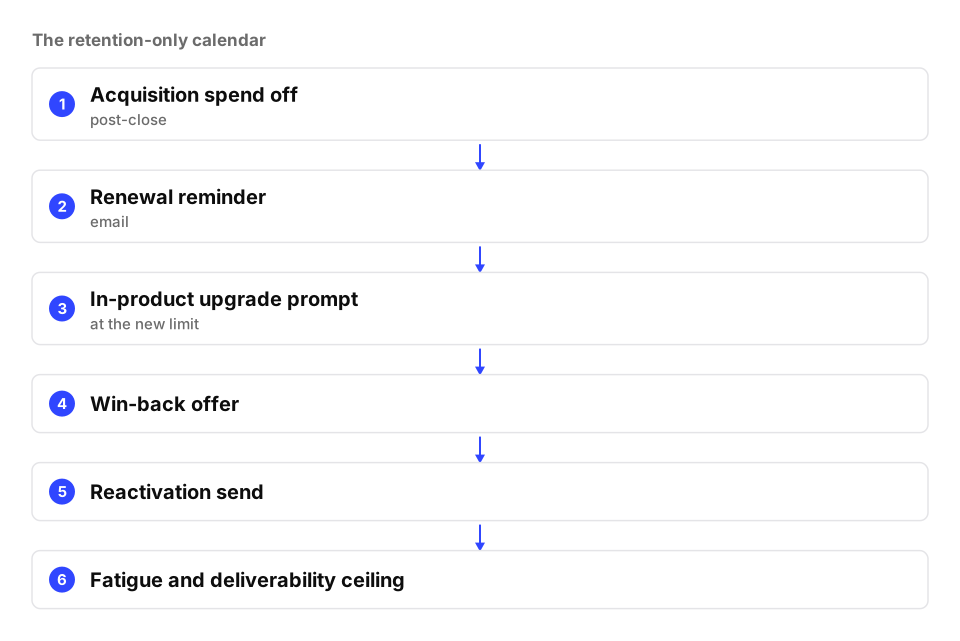
That is a deliverability problem before it is a revenue problem. Gmail's bulk-sender rules put the complaint ceiling at 0.3%, and a reactivation sequence pointed at a list with no fresh top is the fastest route into it I know: the recent-opener segment thins, whoever owns the send reaches further down the engagement ladder to hold volume flat, and placement goes over a cliff about two quarters after the last acquisition dollar was spent. The fix is a headcount argument, which is why it rarely gets made. Every lifecycle segment has to be re-cut on a rolling 30-day active window, and someone has to stand up and say the send volume in the board deck is about to halve on purpose.
That is the quarter that arrives first.
The limit I expect to move first
Here is the call, and it is checkable. Airtable closed first, so Airtable moves first: packaging changes inside two quarters of close, Miro inside four of its Q4 2026 completion. The order is always the same with this owner. Restrict the free tier so the upgrade prompt has somewhere to fire, then move list price on the entry paid plan. Evernote went from about $100 a year to $249 under the same management, a 2.5x move taken in one go.
Run Miro's numbers through it. At about $150 a seat a year blended, a 2.5x move puts the entry tier near $375. The self-serve tail is where that lands, and self-serve is small: 90% of revenue comes from business and enterprise, so individual and small-team billing is something like $60m of the $600m. You can lose 40% of those seats and still be up on the line if the survivors pay 2.5x. That is the arithmetic the owner is doing, and it is why I expect the free ceiling to tighten first, on boards, editors, whichever constraint makes a team of six impossible, before a single dollar of price moves.
The free accounts were a demand-generation subsidy, and a subsidy survives only when someone can show what it converts inside an attribution window finance will accept. What gets defended is the cohort above $100k: more than 750 accounts carrying at least $75m of ARR, out of more than 250,000 organisations. Three in every thousand customers, at least an eighth of the revenue.
Put a diff alert on both pricing pages and watch which line moves. My money is on the free plan's board and editor limits tightening before the entry price changes, and if price goes first I was wrong about the sequence. Then run the same exercise on your own plan table: which line of acquisition spend survives a hundred days under an owner who will not spend $819 a month defending its own brand term.