
How many ads do you NEED to launch per week?
Hormozi's portfolio records 50 or more new ads every week, and that volume is the whole Meta strategy. The number is right for him and wrong for most accounts reading this, because the count that actually sets it is conversions a week per ad set, and his ad sets clear a floor most do not.
The ad set stopped choosing the audience and the creative took over
Before Andromeda, Meta sorted people into interest buckets, the ad set picked a bucket, and everybody inside saw the same ad. The audience layering a media buyer could build inside an ad set was the fee.
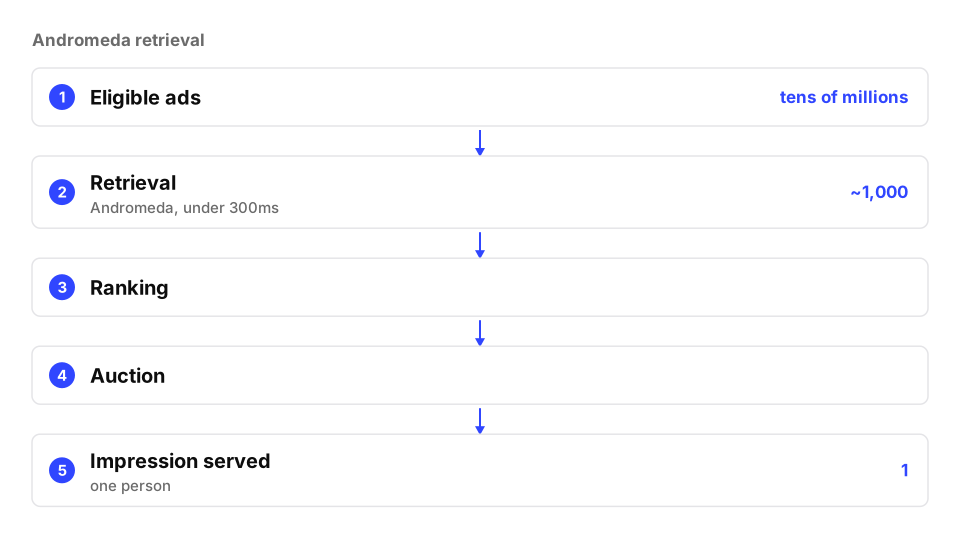
Andromeda is the retrieval layer, and it runs before ranking and before the auction. Every time somebody opens a feed it scans tens of millions of eligible ads and pulls roughly 1,000 candidates for that one person in under 300 milliseconds, on about 10,000x the model capacity of the system it replaced. Meta published the engineering post in December 2024 and had it live across most objectives and placements by October 2025.
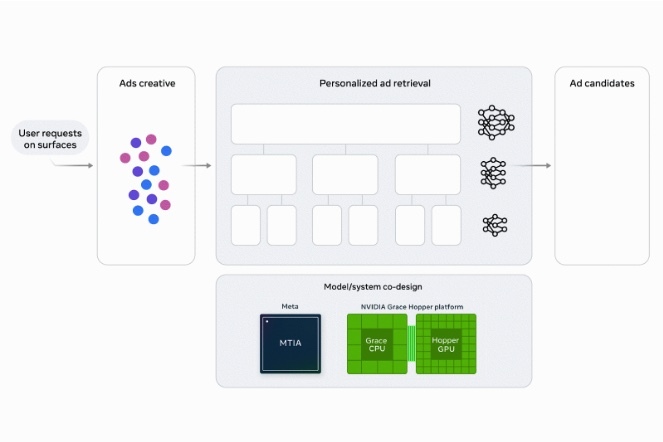
Retrieval takes a person Meta has already identified and chooses which creative fits them. By the time your ad is considered the audience is settled and the variable is the ad, which is why the creative is the targeting now. The one lever left at the moment of selection is what the ad looks like, sounds like and says in its first 3 seconds.
Which makes the ad set structures most accounts still carry dead weight. Every account we audit has some version of the 2021 build: an ad set per interest stack, a lookalike ad set, a retargeting ad set, each with its own budget, each fighting the others in the same auction. All of it was built to select people, and the system now does the selecting. Meta prices the fight, too: auction overlap between your own ad sets is on its list of causes of Learning Limited.
Meta has been dismantling the ad set's powers to match. Audience inputs are suggestions the delivery system reaches past whenever it predicts better performance outside them. Detailed-targeting exclusions came off active campaigns on 31 March 2025, with Meta citing a 22.6% lower median cost per conversion in accounts running without them.
50 copies of one ad is one ad
Volume is the word everybody took away from Hormozi's 50 a week, and it is the wrong word. Meta's system analyses every creative and groups ads that share visual and thematic attributes, then treats the group as one creative, with learning and delivery decisions shared at that level. Upload 50 variants with the same hook and the same offer and retrieval sees one ad competing for one slot.
The account pays for the sameness as well. A library that looks alike from every angle reads to the system as fatiguing, and in the accounts we run it shows up as CPM drifting upward on the repetitive set while a genuinely different ad beside it buys the same reach for less. That gap is the auction's price on repetition, and on prospecting it reaches double digits inside 14 days.
The spread inside a big library says the same thing from the inside. Across large accounts about 5 to 8% of ads become real winners and roughly half get little or no spend. That half is mostly permutations of the ad above it, same hook, new colour, new caption, and the system has already picked the one of them it needs.
Genuinely different means a different reason to buy, a different person saying it, or a different format carrying it. A new first line on the same body is a new concept. A new caption on the same first line is a permutation, and retrieval counts concepts, with 5 to 10 distinct angles per campaign the point at which the pool starts to be worth anything to it.
Fatigue on prospecting now runs a 2-to-3-week cycle in our accounts, down from the 6 weeks or more we used to plan around.
So the production question that decides everything below is how many distinct concepts an account can ship every two to three weeks, and for most teams the honest answer is closer to five than 50.
One campaign, one ad set, 20 to 50 ads
The build that follows from all of this is short enough to fit on one screen, and we rebuild accounts to it in an afternoon.
| Level | Setting | Value | Why |
|---|---|---|---|
| Campaign | Budget | Advantage+ campaign budget, daily | One budget flows in real time to the ad set with the best opportunities |
| Campaign | Ad sets | One, two at most | One learning phase, one auction position, no overlap |
| Ad set | Audience | Broad, Advantage+ audience on | Retrieval chooses the person |
| Ad set | Age | Minimum held as a control only up to 25 | The one hard control still available |
| Ad set | Gender, custom audiences | Suggestions by default; box unchecked to make a control | Leave as suggestions unless a legal or offer reason exists |
| Ad set | Optimisation event | Deepest event that fires 50 times a week | Set in the conversions section below |
| Ad | Count | 20 to 50 live | Retrieval needs a choice to make |
| Ad | Naming | concept_hook_format_version | The exported report becomes the pivot table |
50 is the cap most accounts hit at the ad set level. Some accounts report limits far higher, and I have seen certain media buyers talk about 250 in one ad set, which tells you where Meta is heading and nothing about what your account needs this month. 20 to 50 is the working range, and the low end of it is where most accounts under $50k a month should sit.
The most expensive habit left in the channel is the six-ad ceiling. Meta used to say no more than six creatives in any one ad set, and a generation of media buyers built every test around that sentence. Meta has since removed the sentence from its guidance, and the page it lived on is still live without it. The habit survived the guidance, and I still audit accounts where somebody is rotating six ads at a time into an ad set designed for 50.
Naming is where the money is saved. Every ad carries concept, hook, format and version in its name, or file name, headline and primary text if the team prefers, so that a raw export from Ads Manager pivots by concept without anybody opening a creative. With 40 ads in one ad set that pivot is the only report worth reading, and I would refuse to launch an ad that could not be pivoted.
We run one broad ad set carrying every stage of the funnel at once, because a stage carved into its own ad set takes its share of the 50 events a week with it and leaves both halves learning on less. At this shape the ad set is also the test, and the campaign that used to be called testing has nothing left to do.
Meta is selling more ads and charging more for each one
| Period | Average price per ad | Ad impressions |
|---|---|---|
| Q2 2025 | 9% | 11% |
| Q3 2025 | 10% | 14% |
| Q4 2025 | 6% | 18% |
| Q1 2026 | 12% | 19% |
| Q2 2026 | 12% | 14% |
How 50 a week actually gets made
Hormozi's portfolio records ads every week, and the number is 50 or more. At the last count there were 1,700 active ads across his Meta accounts and 3,700 live on one portfolio company alone. He also says his results are better post-Andromeda across the whole portfolio, which is the opposite of what most advertisers report, and the production system is why.
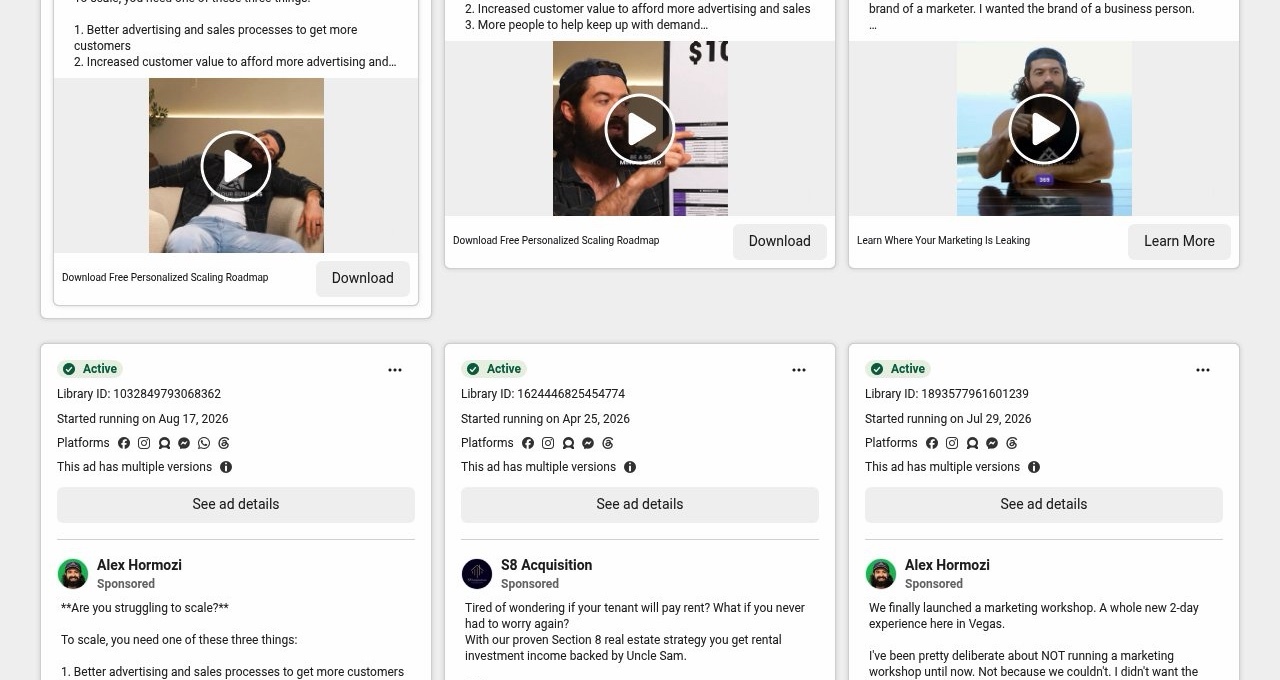
The split is 70/20/10. Seventy percent of output is permutations of the ad that already works, twenty percent is adjacent to it in style and angle, ten percent is wild ideas that might work. The mechanics are cheaper than they sound: he records ten value bodies separately, records thirty hooks separately, and pastes hooks onto bodies to get 300 variants. The gym testimonial ad that carried that business got about 100 versions.
Carry the previous section into that maths. Retrieval groups by visual and thematic likeness, so the 300 is at most a few dozen concepts in the system's eyes, and the thirty hooks are doing most of the work. Hormozi puts 80% of his attention on the first five seconds, and that is the same read from the other side: the hook is the part the system treats as a new ad.
Talking-head is the default format across the portfolio, and I would make the same choice for anyone. It is the cheapest format to make genuinely different, because a new person, a new first line or a new setting produces a new concept for the price of a morning.
Here is the same machine at ten to fifteen a week, which is where an account spending $15k to $50k a month should run. Two people, one phone, one lamp. Monday morning is recording, five to eight hooks and two bodies in ninety minutes each. Tuesday is the edit day, cutting hooks onto bodies and captioning. Wednesday is the load day, naming and uploading into the one ad set. Alongside that, a small creator roster of 3 to 5 people paid a few hundred dollars a week between them returns 6 to 15 clips, each of which is a new face and so a new concept.
That is roughly two working days a week for two people, plus creator management, before anybody has looked at a number. In-house teams sustain it for about six weeks in my experience, because the sixth week is when the founder stops turning up to record and the roster's second invoice lands. The accounts that keep it going have made recording somebody's job description, with the hours in the calendar, and the accounts that treat it as a sprint go back to 6 ads by week 8.
Where the spend goes is the test result
With one budget and 20 to 50 ads in one ad set, the system runs the test for you. It concentrates spend on the handful it rates and starves the rest, and a 5 to 10% hit rate is normal at scale. Five winners out of 50 is a good month.
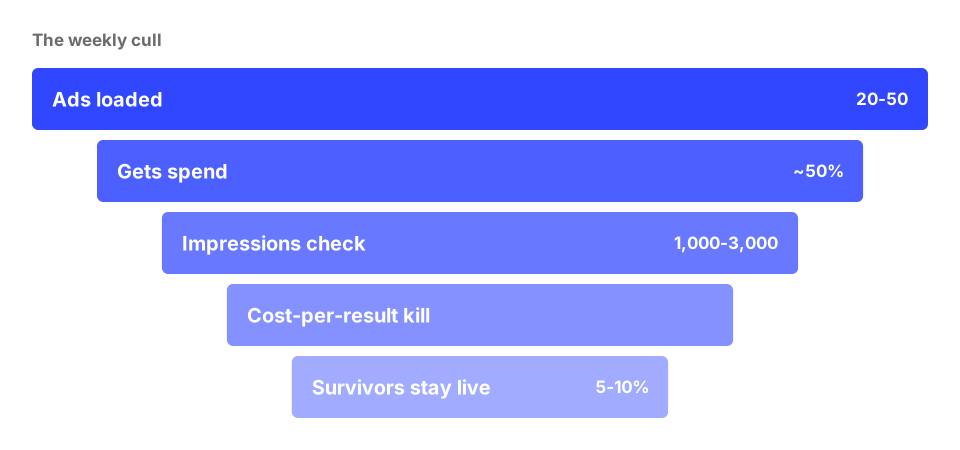
Our reading rules are simple because the report is a pivot table. Every ad gets at least 1,000 impressions before anybody judges it, and I prefer 3,000. We read on day three or four and decide on day five to seven, which is faster than the seven to fourteen days the old system needed and slow enough for a considered purchase to close inside the 7-day click window.
The kill rule needs no conversion to fire. An ad that has spent twice the target cost per result with nothing back is dead, and for a high-ticket purchase I stretch that to three times. Waiting for a conversion to prove a loser is how 40 ads quietly spend the budget of the 5 that work.
The second signal sits in the CPM column. An ad well above the ad set's median CPM that the system also refuses to spend on is retrieval telling you it has seen this creative before and has already decided. Pause it and ship a different concept, because a new caption on it inherits the same verdict and the same CPM.
The 2021 move at this point was to duplicate the winner into its own ad set or its own scaling campaign, and it now costs more than it returns. The copy competes with the original for the same people, and Meta lists auction overlap as a cause of Learning Limited. Duplication is a significant edit, so the copy restarts learning from zero and has to find its own 50 events in seven days. And splitting one budget in two halves the data each half learns from.
What we do is feed the winner. A winning concept gets its 70% treatment from the previous section, new hooks and adjacent angles shipped into the same ad set over the following two weeks, so the system has fresh versions of the thing it already likes before the two-to-three-week fatigue cycle takes the original out.
All of this only reads cleanly if the naming convention held. A pivot on concept across forty ads shows, in one column, which idea is carrying the account, and that column beats any A/B test Meta will sell you.
50 conversions a week or Meta is guessing
Everything above sits on one number. An ad set needs about 50 optimisation events in the seven days after its last significant edit or it goes Learning Limited, which is the system telling you it cannot optimise on the setup it has been given. Shops ads carry their own floor of 17 purchases through the website and 5 through Meta in the same seven days.
Price it. At a $100 target cost per result, 50 events is $5,000 a week, or roughly $700 a day, per ad set, and that is the spend at which the system starts optimising. An account spending $10k a month cannot clear it on purchases, and every second ad set it opens halves the events each one gets.
Below the floor the move is up the funnel. Optimise for add to basket, or initiate checkout, or a qualified lead event, whichever fires 50 times a week, and move the event back down once spend clears the threshold. Change budget rarely and in steps, because a budget set far too small or far too large gives the system a false picture of who to optimise for, and every change big enough to count as a significant edit restarts the 7-day clock.
Lead accounts have their own trap. Optimise for registrations and Meta buys the cheapest people to reach, who are the least serious. An SMS one-time passcode on the form filters them out and moves lead quality out of all proportion to the friction it adds, and it leaves the optimisation event exactly where it was.
Sales accounts get a better lever once volume is there. Maximise value tells the system you will pay twice the cost for a buyer who spends five times as much, and the pLTV model behind it stabilises on 30 to 50 high-value purchases a week with value attached.
Then read the result against the right ledger. Meta's attribution change announced on 3 March 2026 counts link clicks only as click-through, and the engaged-view threshold dropped from ten seconds to five. Reported ROAS jumps by a third or more on the change while CRM revenue moves by single digits. The scale decision is made on CRM.
Two things justify a second ad set: a different offer, and a different country. Each carries its own 50 a week.
The offer is the half of the system Meta cannot optimise
Retrieval matches a creative to a person. It cannot see what the click lands on, and landing page conversion rate is the one number Andromeda never reads.
Hormozi's own read of his library is that about 80% of the ads are proof, and he stopped appearing in the gym company's ads two years ago to run customer testimonials in his place. That is message-match from the ad side: the ad promises an outcome somebody like you already got, and the page carries the same promise, with the same headline as the hook and one job. The sitelinks come off the ad so nothing leaks traffic anywhere except the funnel. An instant form is the fallback when the page cannot be built in time, and it trades lead quality for volume at roughly the same cost per lead.
A weak offer has a specific look in Ads Manager, and most media buyers misread it. The system finds the people, they click, the page fails them, spend drifts to the next ad, and Ads Manager shows creative fatigue arriving in week one. The buyer then briefs new hooks against an ad that was doing its job. Before a concept is declared dead I want its landing page conversion rate beside its CTR, and a healthy click-through over a flat page puts the fault on the page.
Read his live ads at facebook.com/ads/library. The Ad Library shows every active ad by page name, with primary text, headline and call to action, and reading 50 of them in a row is the fastest offer education available, at a cost of one afternoon.
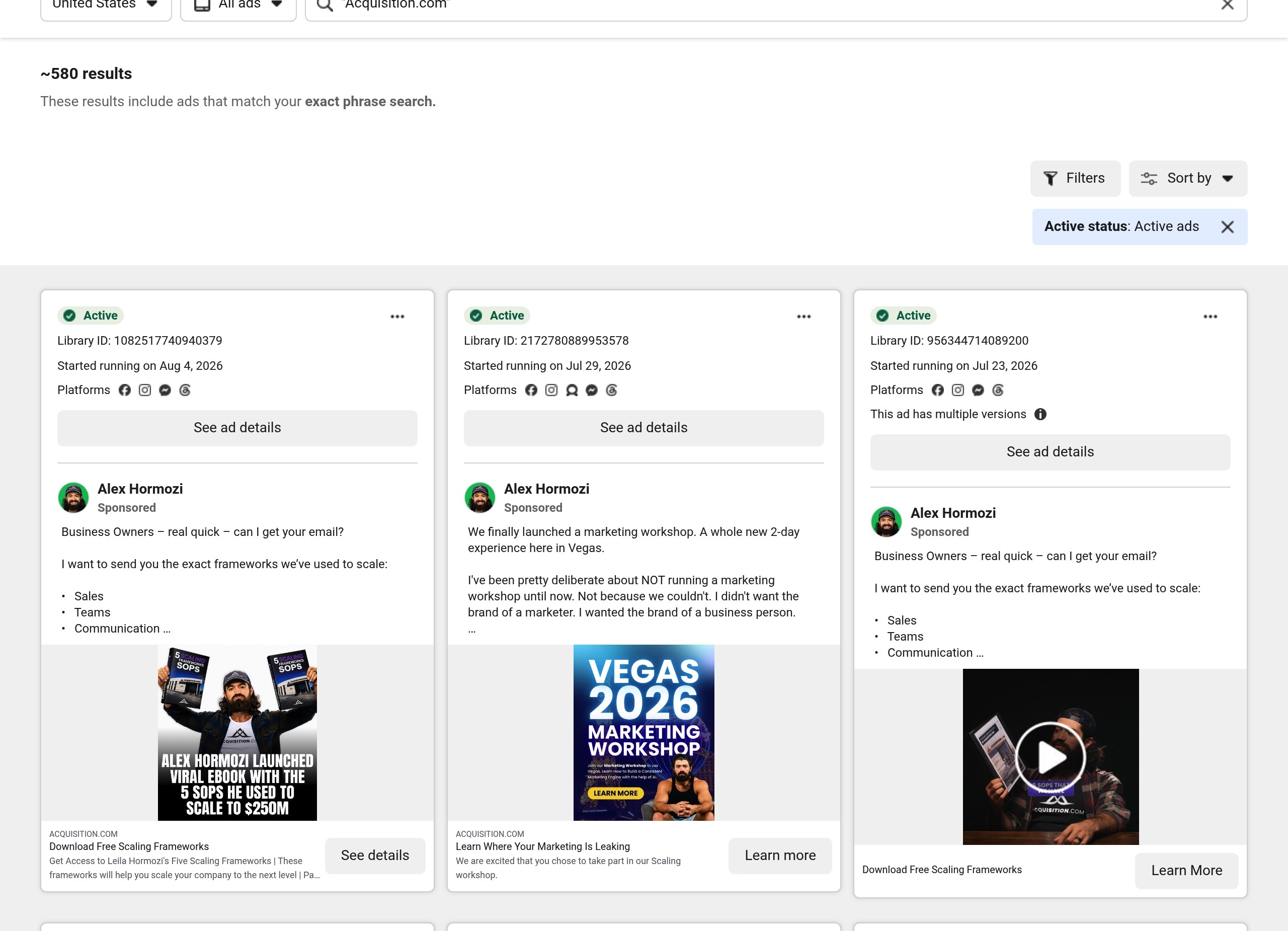
The prize when offer and creative match is duration. His portfolio carries ads that have run profitably for 8, 10 and 12 months in front of millions of people.
What not to copy, by monthly spend
Hormozi's 50 a week rests on preconditions almost nobody reading this has. A founder who records every week. A portfolio north of $200M a year in revenue, with coaching and software margins that can carry a high cost per result. And a brand that pre-sells the click before the ad is served: acquisition.com takes about 62,600 organic visits a month, the founder's bio page alone takes 23,500 of them, and the following was built to 5 million people in 24 months. His ads land on people who already know the name.
So the number is set by conversions, and this is where we set it.
| Monthly spend | Ads live per ad set | Ad sets | New concepts |
|---|---|---|---|
| Under $15k | 10 to 15 | One | 3 to 5 a fortnight, with the event moved up the funnel until 50 a week clears |
| $15k to $50k | 20 to 30 | One | 5 to 8 a week, once the ad sets have been collapsed into one |
| $50k to $250k | 30 to 50 | One or two, split by offer or country | 10 to 15 a week, with a creator roster |
| Above $250k | 50, cap permitting | Two or three, split by offer or country | 50 a week, and it is a production job |
Below $15k the account is a conversions problem before it is a creative problem, and I would spend the first month on the event and the form and leave the roster for month two. Between $15k and $50k the biggest gain in every account we take on is structural, collapsing five ad sets into one and watching cost per result drop by double digits on the same spend, because the ad sets had been bidding against each other. Above $50k the creative machine from earlier is the job, and above $250k it is a full-time producer plus a creator roster of five or more.
Four things to stop doing:
- Rebuilding the interest ad sets, because the ad set no longer selects anybody.
- Duplicating the winner into its own ad set or campaign, because overlap and a restarted learning phase cost more than the copy returns.
- Running a separate testing campaign, because the ad set's allocation is the test.
- Chasing 250 ads per ad set before 50 conversions a week is cleared, because volume without events is guessing at scale.
Within a year the 50-ad cap goes for most accounts, because a retrieval layer built to choose among a thousand candidates a person has no reason to cap one advertiser at 50, and Meta is already letting some accounts far past it. When that happens the accounts still carved into interest ad sets will be paying a structural tax that gets larger every quarter, with the price per ad up 12% year on year and impressions up 14%, and the ones running one broad ad set fed by a weekly recording day will find the ceiling has quietly moved above their production capacity. The constraint was always how much genuinely different creative a team can make, and the platform has now removed every excuse that used to hide it.