

Who uses Harvey.ai? Most of the Am Law 100...
| Dec 2024 | 28% |
|---|---|
| Aug 2025 | 42% |
| Mar 2026 | 60% |

The acquisition budget is a payroll line called cost of revenue
Start with the number everyone can see. Harvey's paid search runs at $1,377 a month for 333 visits across 65 keywords, and the organic traffic it earns would cost about $139,000 a month to buy. Judge the growth engine by the ad account and you would conclude there is none, at a company selling to 1,400+ customers in 60 countries at an $11B valuation.
The number that never reaches a marketing deck is roughly 180 legal engineers, every one a former practising lawyer. Multiply through and the OTE line alone sits between $40M and $58M a year, before equity, before management, and before the travel the posting is honest about... two to three trips a month at one to three days each, which across 180 people is a small airline.
Against 1,400+ customers it is about one lawyer for every eight accounts. Against 100,000 lawyers on the platform, one Harvey lawyer for roughly every 550 users. It dwarfs everything that carries the word marketing, starting with the $1,377 in the ad account.
A lawyer in every deployment is cost of revenue, and the March 2026 round's stated use of proceeds says so in plain terms: growing the embedded legal engineering teams supporting customers globally. That is delivery language, and it keeps $40M to $58M out of every CAC calculation a board sees.
What would let you price it properly is unpublished: no ramp time for a legal engineer, no per-account margin, and no count of the team since the 180 figure, even though customers have gone from 1,400 to 2,400+ since. I am working from the one number on the record, 180.
The pre-sales third of this function, the people running discovery and demos, is sales and marketing spend by any honest definition. No CFO will book it there, because the moment it moves, the payback arithmetic on an $11B story looks very different. If the three teams are equal, that is 60 lawyers running discovery and demos at $220,000 and up, filed under cost of revenue.
One lawyer in every deployment, a pod for the few
Read the job postings as an org chart and the function is a funnel with a JD at each stage.
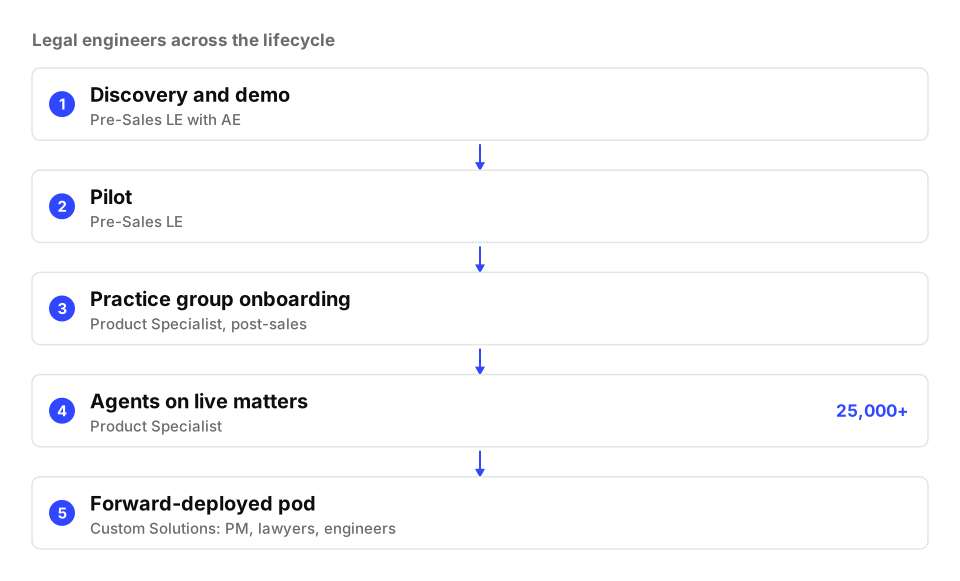
Harvey splits legal engineering into three teams. Pre-Sales Legal Engineers lead discovery, demos, trainings and onboarding alongside AEs and CSMs. Product Specialists own post-sales. Custom Solutions works both sides of the contract. The shape is pipeline, activation, expansion, and the person running each stage is a former practising lawyer on a $220,000 to $320,000 OTE.
The pre-sales role collapses two jobs most companies keep apart. The sales engineer who runs the demo and the activation owner who runs onboarding usually sit on different quotas, and the handover between them is where enterprise software goes to die. Here they are one body with a JD, so the partner who saw the demo gets the same person when the first live matter goes into Vault.
Above that layer sit the forward-deployed pods: a product manager, one or two lawyers and software engineers, working bespoke for the customers that need it. The pod is discretionary. The legal engineer is in every deployment, always, on the stated principle that a subject-matter expert is what lets a customer get full value from the platform, and the posting has her travelling two to three times a month for one to three days at a time.
The bar is high on purpose. Posted minimum is a JD plus three years at a top-tier firm or in-house, and the number given on stage was that most of the team has eight to ten years of practice. A partner treats that person as a peer, which is the entire reason the role exists at associate money.
Post-sales goes deep enough that Harvey describes it as sitting down with a full practice group to build agents on the firm's real matters. That is where the 25,000 custom agents across M&A, diligence, drafting and review come from.
What is unpublished is who owns which surface when a pod and a standing legal engineer sit on the same account: whether the LE stays relationship owner while the pod ships and leaves, or the pod absorbs the account. I would want that answer before copying any of it, and Harvey has given no ratio of pods to its 1,400+ customers.
- Pre-Sales: discovery, demos, trainings and onboarding alongside AEs and CSMs, the pipeline and activation stage in one hire
- Product Specialists (Post-Sales): sitting with a full practice group to build agents on live matters, the activation-to-expansion stage
- Custom Solutions (Pre- and Post-Sales): bespoke pods of a PM, one or two lawyers and engineers, for the accounts that need them

Two numbers no finance team would put on the same page
Put them side by side and the ad account stops looking like a growth engine and starts looking like a hygiene line, the branded terms somebody defends because it would be embarrassing not to. The lawyers are the channel. I now read every enterprise AI company the same way, and ask which payroll line does the persuading before I ask to see the media plan. When the answer is a headcount figure, the CFO owns acquisition and marketing owns the website.
In a profession that trusts only its own, the lawyer is the positioning
Specialised legal LLMs that market themselves as hallucination-free were found in a 2024 study to hallucinate 17% to 33% of the time. A partner whose name goes on the filing takes accuracy on the word of another lawyer and nobody else, and no volume of content marketing changes that. Harvey's answer is to make the vendor a lawyer. The posting calls the legal engineer the trust layer across the entire customer lifecycle, from the first pilot to the most complex custom workflow, which is a positioning statement published at a careers-page URL.
Look at who fronts the company and the pattern repeats. A CEO who was a securities and antitrust litigator at O'Melveny. A Wachtell corporate partner as Chief Product Officer from July 2023. A sales team hired out of White & Case, Latham and Skadden. The person put on the SaaStr stage to explain the model in public was the head of legal engineering.
The published marketing is proof. Customer stories built on adoption numbers. The stat that AI adoption across firms and legal departments went from 14% to 43% in two years. A Customer Advisory Board launched alongside the March round. And Harvey Academy's Certified Legal Engineer path, self-paced, open to anyone, with a shareable badge, which turns a customer's own associates into credentialed advocates who post the badge on LinkedIn where the next firm's associates will see it.
Then the words on the product pages, written for the partner and the CIO in the same breath. Legal infrastructure. Never trains models. SAML SSO, audit logs, IP allow-listing, data lifecycle management. Integrations into Word, Outlook, iManage and NetDocuments. This is the security questionnaire answered in advance, and I think it is better marketing than any ad Harvey could run, because it deletes the meeting where enterprise deals stall for a quarter.
What I cannot show you is ad creative, because there is none to quote, and the content cadence is unpublished. The payroll line does the job a positioning campaign does at a generalist tool; the brand work is done by the hire, at $220,000 to $320,000 a head.
The expansion loop is a partner walking across the hall
Once the first group is live, the growth question is how the second one buys. In most B2B AI accounts we audit, expansion is a lifecycle email sequence and a CSM quarterly review, which is why it stalls at the pilot team. Harvey's expansion unit is a practice group.
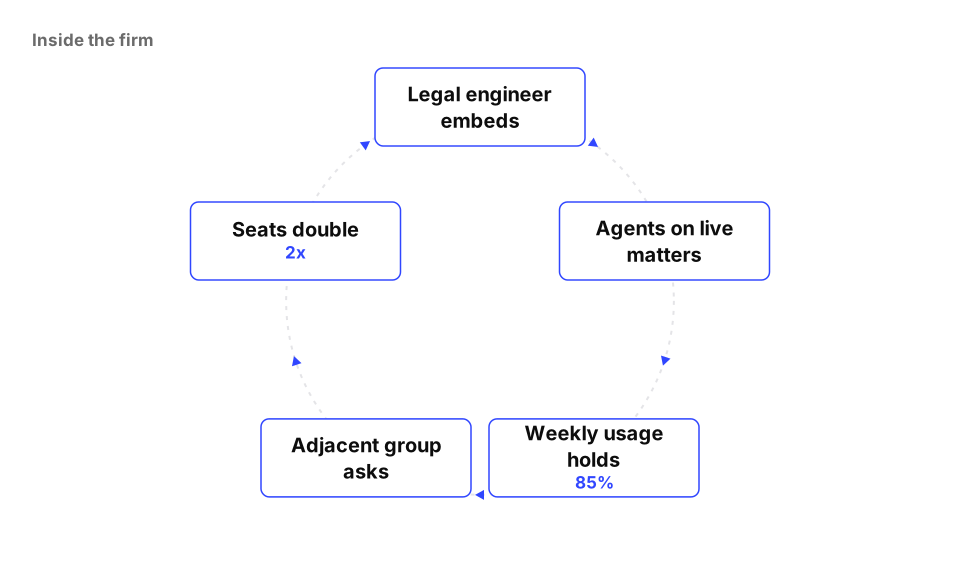
HEUKING shows it at pilot scale. Pilot of about 50 users in July 2024. Access extended to the entire legal team by autumn 2024. Licences up nearly sixfold since. Of monthly actives, 85% use it weekly, and between 89% and 100% of new users are still active a month after onboarding depending on the group, across browser, Outlook, Word and the iOS app.
CMS is the scaled version: 3,000 lawyers a year earlier, then 7,000 lawyers and staff across all 21 member firms in more than 50 countries, 93% reporting productivity gains, up to 117.9 hours saved per lawyer a year. Across customers, median seat count doubles inside twelve months. And the whole thing was seeded by a reference no other vendor could buy: Allen & Overy at launch, 3,500 lawyers across 43 offices, exclusive.
The mechanism is the post-sales legal engineer. She sits with one group and builds agents on its live matters, so usage holds because the tool is doing that group's actual work. The adjacent group notices, and in a partnership the adjacent group asks the partner who runs the first one. The second sale is a conversation between two equity partners, and the lawyer walks across the hall to a group of 50.
Price it. Reported seat pricing is $1,200 to $2,000 a month. A 50-lawyer practice group crossing that hall is $60,000 to $100,000 of monthly recurring revenue, $720,000 to $1.2M a year, with no SDR touching it and no discount to negotiate. The expansion budget is the same $220,000 to $320,000 salary that did activation, spent again.
The precondition is the ownership structure. Partners buy for their own groups and talk to each other across the hall, so referral runs along the corridor; a matrixed enterprise routes the same conversation through procurement. I would not expect the identical loop to fire inside a 30-lawyer corporate department, where there is no adjacent group to sell to and the second sale needs a budget owner who was never in the room, which is the test Harvey's 500+ in-house legal teams are about to run for it.
Palantir staffed engineers, Harvey staffed the buyer's own credential
Harvey shares the accounting with a whole category. It hired differently.
The lineage is Palantir, which until roughly 2016 had more forward-deployed engineers than software engineers. The current wave is a hiring boom: FDE listings up more than 800% between January and September 2025, about 5,230% above that January baseline by April 2026, with New York holding around 35% of postings against San Francisco's 11%. AWS committed $1B in June 2026 to an FDE organisation embedding pods of five to six engineers per customer. OpenAI spun out a deployment company in May 2026 that raised $4B at a $10B valuation. The demand under all of it is one finding: roughly 95% of enterprise AI pilots deliver no measurable business impact, and everybody is now paying people to make the pilot land.
Advertised FDE compensation runs from about $170,000 to over $200,000. Harvey's legal engineers start at $220,000 and top out at $320,000, which is mid-level associate money, and the overlap with a law firm's own pay scale is the design. An FDE makes the software fit the customer. A legal engineer makes the buyer believe it works, and in a profession that accepts only its own judgement, belief is the constraint on the sale. The category had already relabelled deployment as the growth cost; Harvey paid a $50,000 to $150,000 premium per head for the version of the hire a partner will listen to.
What a forward-deployed hire costs, by who gets hired
| Posted role | Posted low | Posted high |
|---|---|---|
| Palantir | 135000$ | 145000$ |
| Distyl AI | 150000$ | 250000$ |
| Glean | 160000$ | 270000$ |
| Ramp | 161500$ | 190000$ |
| Harvey | 220000$ | 320000$ |
Which budget owns the lawyer depends on what you need her to do
The argument for the budget meeting is a mapping exercise, so here it is as one, against Harvey's three posted teams.
| Harvey team | What it does | Which budget would claim it | Buy or staff |
|---|---|---|---|
| Legal Engineers (Pre-Sales) | Discovery, demos, trainings and onboarding alongside AEs and CSMs | Marketing or sales engineering | Buyable for a pilot period; staff once deal volume justifies a standing hire |
| Product Specialists (Post-Sales) | Practice-group activation, building agents on the customer's live matters | Customer success | Staff; this is the relationship and it does not hand over well |
| Custom Solutions (Pre- and Post-Sales) | Bespoke pods with a PM and engineers for the accounts that need them | Professional services | Buy per engagement and price it to the customer |
My call on each row. Pre-sales legal engineers run discovery and demos; that is demand generation, and I would book it in S&M because it is the only way the CAC arithmetic stays honest and the only way a marketing leader gets credit for the pipeline it creates. Post-sales is customer success with a domain premium, and the premium is the whole point, so do not let it be benchmarked against a standard CSM salary. Custom solutions is professional services, priced to the customer on a per-engagement statement of work.
The buyable version exists. For clients we brief domain experts into activation on the top decile of accounts and buy that expertise on a day rate for the pilot period. It costs more per day and far less per year, and it forces the question Harvey's structure never has to ask: what does the expert do in month five, once the group is live and the agents are built?
Two preconditions. Six-figure contracts, which $1,200 to $2,000 a seat across a practice group produces without effort. And a buyer culture that rejects outside expertise. Without the first, the lawyer costs more than the account. Without the second, an ordinary FDE at $170,000 to $200,000 is enough and the domain premium is money on the floor.
Sixty times the customers, one published count of legal engineers
| Q1 2024 | 40 |
|---|---|
| Q4 2024 | 235 |
| Q2 2025 | 337 |
| Q3 2025 | 500 |
| Q1 2026 | 1400 |
| Q3 2026 | 2400 |
Most B2B AI companies cannot carry this and should not try
So, four things not to do. Do not rename your CSMs as engineers and expect a partner to notice the difference. Do not hire a subject-matter expert per logo. Do not build a pod for every account when Harvey itself gives pods only to the customers that need them. And do not book the cost as marketing and then measure it on MQLs, because a legal engineer produces zero MQLs and a great deal of revenue, and the dashboard will tell you to fire her.
The transferable lesson is smaller than the headline: domain-expert-led activation on the top decile of accounts, and a month-zero decision about whether the expert is staffed for eighteen months or bought by the day for the pilot. Nothing in between survives a budget cut, and at five-figure ACVs neither option does, because the lawyer costs more than the cohort she supports.
Now the calls I will be held to. Harvey is moving from the Am Law 100 to 500+ in-house legal teams, 50 asset managers and 2,400+ organisations. One lawyer per eight accounts does not survive that. The promise in the March use of proceeds to grow embedded teams globally will be met, in practice, by the Academy's Certified Legal Engineer badge doing the post-sales job for the long tail, with the human reserved for accounts whose contract values carry her. If the published count is still near 180 in a year while the customer number has doubled again, that is what happened.
And outside law: the first companies copying this in categories where the ACV does not carry a senior domain salary will have quietly cut the role within a year of announcing it, and the cut will be dressed as a reorg into customer success.
The budget line that bought the Am Law 100 is a luxury of deal size, and the line sits at a 50-lawyer practice group paying $1,200 a seat.