
Six times the sending, two-thirds of the answers
A human SDR seat sends about 1,150 outbound touches a month. An AI seat sends 7,400. That is 6.4x the volume, and the reply rate fell from 4.7% to 2.9% to pay for it. I do not read that as a tooling win. I read it as the same inbox absorbing six times the mail and repricing attention accordingly. Specialised outbound worked because sending was scarce and answering was cheap. Both of those things stopped being true.
Specialisation was an arbitrage on cheap attention
The SDR/AE/CSM split was a media buy wearing an org chart. The seat was the ad unit, the sequence was the creative, and the inbox was inventory priced at a 4.7% answer rate. Sending cost nothing, one stranger in twenty answered, and you booked the margin between the cheap first touch and the expensive close.
The economics only ever worked in aggregate, and the aggregate hid a lot. A fully loaded SDR runs $98,000 to $173,000 a year and generates about $4.7M in pipeline, which reads like a 27x return until you price what you are buying: 1 to 2% of touches convert into a meeting, 16.6% of SDRs consistently hit quota, and one seat supports 2.6 AEs. Then put the clock on it. Median tenure is 1.9 years and the productivity plateau lands at 15 months, so you pay for 23 months to get about eight months of a rep at full output, on a treadmill where 34 to 40% of them leave every year.
Internal promotion rates fell from 34% in 2020 to 16% in 2024. The SDR job was a two-year apprenticeship priced at a discount, and the exit into an AE seat was the second half of the compensation. Halve the promotion rate and you are asking people to do the hardest work in the funnel for a $55,000 to $60,000 base.
So when founders tell me the roles blend back into one full-cycle seller, selling time goes from 25% to 75% and rep-to-manager doubles from 7:1 to 14:1, I hear the arithmetic talking. 36% of B2B companies cut sales development last year, 19% grew it, and another 36% merged SDR and BDR into a single hybrid seat.
The channel commoditised itself in three years
| 2024 | 1% |
|---|---|
| 2025 | 9% |
| 2026 | 34% |
What breaks first if you just buy more seats
Deliverability, and it goes fast. 47% of attempted AI SDR deployments hit a domain-reputation wall inside the first 90 days, so the modal outcome of buying volume is a burnt sending domain and a quarter spent warming replacements. Only about 2% of companies implement AI SDRs successfully, and the failures share one cause: they bought the seat and waited for autonomy. The tool sends 7,400 touches a seat; the operating model around it is unstaffed.
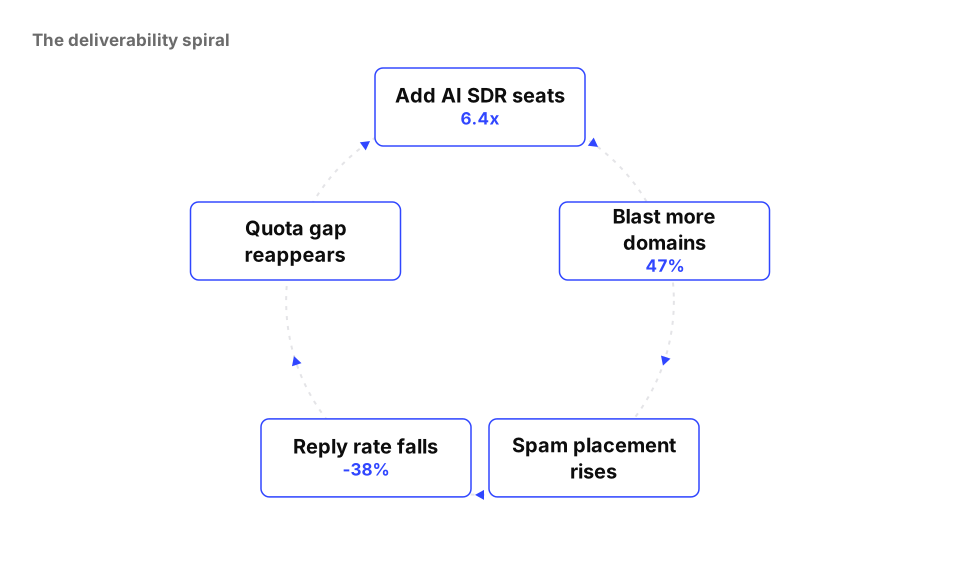
Then the quality problem, which shows up a quarter later in someone else's number. AE win rates on AI-sourced opportunities run 9 to 12 percentage points below human-sourced at the average B2B SaaS company. The cheaper meeting is a structurally worse meeting, so the sales development line looks efficient while the AE line absorbs the cost. If your comp plan pays on meetings booked, you are paying a bonus for a 9 to 12 point drop in close rate.
Look at where the reply gap sits. AI holds within about 1.2 points of human reply rates at manager level and below, widens past 1.7 at VP, and crosses two full points at CISO and C-suite. The machine performs best with the titles that cannot sign a contract, and the gap doubles by the time you reach a CFO.
The measurement layer hides all of it. Apple Mail Privacy Protection, running on more than 95% of Apple Mail users, pre-loads tracking pixels and inflates open rates by an estimated 18 points, so the metric your team screenshots into the weekly is mostly robots opening mail. Meanwhile 58% of all replies come from the first email in a sequence, and campaigns of 50 recipients or fewer reply at 5.8% against 2.1% for blasts.
SaaStr's write-up of its own experiment went round every operator group chat I am in: 8 to 9 human sellers down to 1.2 humans plus 20 agents, with the AI BDR carrying 25% of new pipeline in 90 days. Read the denominator before you copy it. That is a media business selling to an audience it already owns, with an inbound list nobody had to cold-mail.
What I would do on Monday: cap AI sending at manager-and-below titles, put senior humans exclusively on VP and above, kill open rate as a reported metric, and hold campaign size under 50 even though the seat can do 7,400.
Demand creation is the only line item left
Attention is the scarce thing now, so the pipeline number moves onto marketing's side of the ledger and marketing has to find inventory nobody has bid up yet. Right now that is the answer engine. ChatGPT went from 300 million weekly actives to 800 million in a year. AI Overviews sat on 6.49% of queries last January and settled at 15.69% by November, and where they appear click-through drops 34.5%. Add the 58.5% of Google searches that already end without a click and the SERP becomes a place where your brand gets described to a buyer who never arrives.
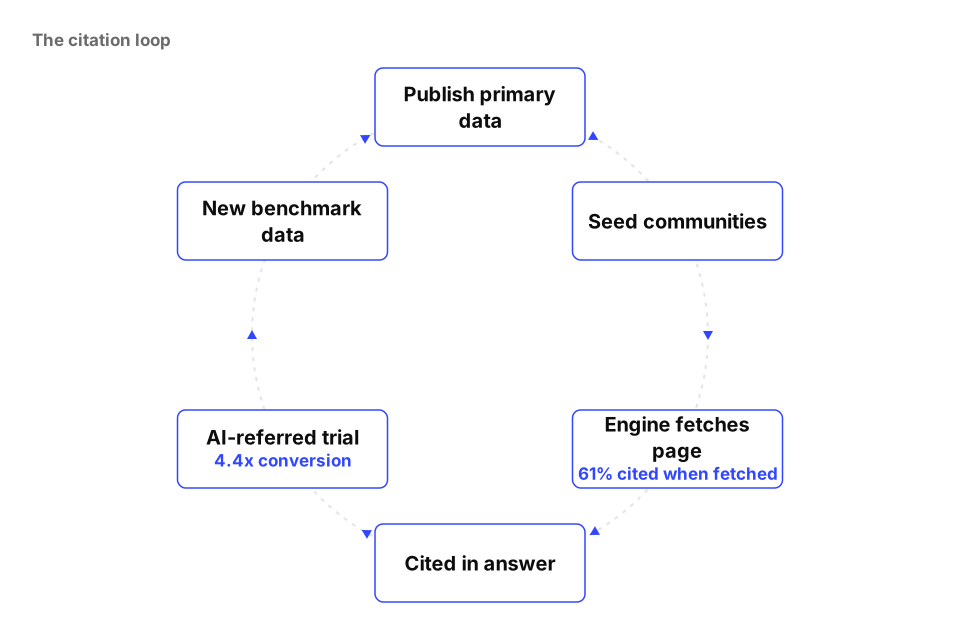
The economics of that traffic beat anything in the paid mix. LLM-referred visitors convert at 4.4x traditional organic on average, and one software vendor measured 0.5% of its traffic driving 12.1% of signups in a 30-day window, a 23x conversion premium.
Here is what it costs, because the write-ups never say. One B2B SaaS programme took AI-referred trials from 575 to over 3,500 in seven weeks, and the input was 66 optimised articles shipped in month one, with the first citations landing inside 72 hours. Sixty-six articles in four weeks is three a working day, which no existing content calendar and one writer will produce. Measurement is the cheap part at $300 to $1,500 a month for share-of-answer tracking. The expensive part is production capacity and someone senior deciding what the 66 pieces say.
The argument practitioners are actually having this year is about Reddit, the single most-cited source in ChatGPT answers. Community sources earn a citation 84% of the time a model fetches them against 61% for your own domain, which is why half of B2B SaaS is quietly seeding threads and the other half is calling it astroturfing that gets you banned from the subreddit. Both are right. The version that works is your customers answering in public; the version that gets roasted in the comments is your PMM posting as a curious buyer.
Before you present any of it, fix the windows. Sourced runs 90 days back from opportunity creation, influenced 180 plus everything through close. Ask a board for 25-45% marketing-sourced and 60-85% influenced while your reporting still runs a 30-day window, and a working programme reads as a failure. Rewrite the comparison and pricing pages the same month, so a model can quote a paragraph unedited.
Where the machines get their answers
| Source type | |
|---|---|
| Review sites | 28% |
| Communities | 22% |
| Trade media | 18% |
| Vendor blogs | 15% |
| Independent | 10% |
| Primary data | 7% |
What I would kill in Q1 to pay for it
Here is the reallocation, in the order I would do it. I stop adding human outbound seats. A fully loaded SDR seat costs $11,400 a month and an AI seat costs $2,800, but the mix is the real argument: the human-only pod generates $187,000 of pipeline per seat per month, the AI-only pod $94,000, and the one-human-two-AI pod $278,000. Cap the pod at that configuration, hold human headcount flat, and every incremental dollar that would have bought seat eleven goes somewhere else.
Somewhere else is where the machines get their answers. I would fund three lines. A named owner for review platforms and forums, whose entire job is G2, Capterra and the subreddits where your category argues. One primary-research publication a quarter that other people have to cite because nobody else holds the data. And $300 to $1,500 a month of answer-engine measurement against a 30% share-of-answer target by month six. The measurement is rounding error against a $11,400 seat. The head is the actual decision, and it is one head, not a team.
Then inbound response time. AI answers an inbound lead in under 60 seconds, human SDRs take 42 to 47 hours, and 78% of buyers buy from the first vendor that responds. If your routing still queues an inbound demo request behind a shift pattern, fix that before you brief another campaign.
Vendors have already read the room. Pricing is moving from the seat to the agent, and 40% of enterprise applications are expected to embed task-specific agents by the end of 2026, up from under 5% in 2025.
My call for the next twelve months, so you can check it. Share of outbound mail sent by AI seats passes half, up from 34%. Junior SDR postings fall further from their current 31% decline. And in $25,000 to $75,000 ACV businesses, marketing-sourced pipeline moves to the top of the 30 to 45% band, because it will be marketing's number whether or not marketing asked for it.