The feature they refused is the one people describe
The standard telling is that Granola grew on word of mouth because the product is lovely, which explains nothing. Plenty of lovely products die quietly. What Granola has is a recommendation with a fixed shape, and the shape came from a refusal made in stealth.
The app sits on the laptop, takes device audio and writes the notes, so the Zoom, Meet and Teams participant lists stay exactly as they were. Bot-based tools put a named attendee in the call, and that visible row is the most-described object in the category.
Read how users actually rank these tools. In a head-to-head thread against Google, Zoom, Notion and Otter, the reviewer puts Granola first and the first supporting clause is "no bot joining meetings, it captures audio directly", ahead of summary quality and templates.
The $125m Series C at $1.5bn is the receipt for that sentence.
The bill is real. A colleague who missed the call gets no shareable recording. There is no MP3 import, so every interview already on your drive stays outside the product. Background transcription of the calendar is off, so coverage depends on a human opening an app. Granola spent the enterprise checklist to buy a sentence people say out loud, and 57% of the people saying it were in leadership roles by the Series A.
The two numbers that bought the round
Read the retention figure as an acquisition number. Granola buys no media, so the sales force is whoever opened the app this week, and seven in ten of them did. The revenue line shows what that compounds into once the recommendation lands inside companies: 250% in the quarter before the round, which is what carried the valuation from $250m to $1.5bn in ten months.
What the notepad does that the marketing site cannot
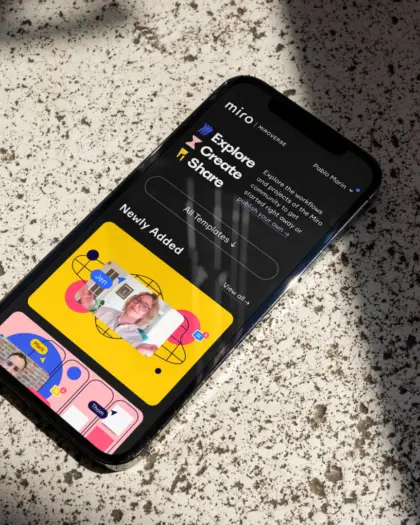
Read the app as the creative, because it is the only creative here. Connect a calendar, run your next meeting, setup done in under five minutes. Twenty-five free meetings before anyone asks for money. That is the whole funnel, and it runs on a domain with a Domain Rating of 0.6, zero ranking keywords and $0 a month on paid search.
What you typed renders in black, what the model wrote renders in grey, your own notes auto-bold as you write them, and one click zooms from any AI line into the exact spot in the transcript it came from. That colour split is the trust mechanic, and it does the job of a compliance page, a footer disclaimer and an objection-handling deck on a $35 Enterprise seat.
It pays commercially. 57% of users were in leadership roles by the Series A, and the ones who stuck ran six meetings a week. A VP forwarding notes to their team is putting their name on the accuracy of a document a model wrote; the black-grey split marks which lines they vouch for, and the transcript zoom lets anyone who challenges one check it in under a second.
The mobile build carries the same logic. Start and stop from the Lock Screen with one tap, notes on outbound phone calls, Google Calendar sync, a 5.0 average on the App Store listing.


The share link is doing the selling
The loop is small enough to draw on a napkin. The meeting ends and the notes, action items and follow-ups are ready in that same moment. The user copies the summary or emails it round to the other four people on the call, and pasted at the bottom of that text is a line nobody asked for and nobody minds: Chat with meeting transcript: notes.granola.ai/d/...

That link is the entire paid media plan. It ships the second-best feature, chat across your transcripts, to people who never installed anything, at the exact moment they have a reason to click, because the thing on the other end is the meeting they just sat in.
This is the only part of the motion a marketer could have specified. Refusing to send a bot into the call was a product decision made in stealth. The share artefact is a URL, a colour and, later, a folder. Shared folders arrived with 2.0, a Sales Calls folder anyone on the team drops notes into, and Spaces at the Series C added the access controls that make that structure survivable in a company with a security review.
Now price the other side of it.
Granola pays for every set of notes it generates, so cost scales linearly with usage. A free tier that generous is a media budget denominated in inference. Most CMOs would take that P&L line over a bought impression, because every dollar of it produces an artefact with a link in it.
Crunched cost five people and six weeks
Granola has run exactly one deliberate campaign worth the name, and I can tell you what it cost. Crunched went out in December 2025, built over roughly six weeks by a marketer and a design engineer, with five people in total contributing to ship it. The chief of staff put over 24 hours into tweaking the AI prompts alone. Before launch they showed it to about ten users from different backgrounds and industries. That is the whole line item, inside a team of around 50 at the time, 87 by February 2026.

Two decisions made it work. The first was timing: the house default is 9am Pacific because San Francisco is the biggest market, and for Crunched they went Tuesday, 8am UK. The second was that one person sat and replied to every single post about Crunched, tagged or not, from 8am until nine that night. Thirteen hours of one salary kept the name on the timeline for days.
Now the number that matters. Click-through on something like this runs in the low single digits, which is why most of these end up in a deck as an impressions figure and nobody asks again. Crunched got roughly 25% of people sharing their result, and the week after launch was the highest acquisition week Granola had ever had.
Share rate is the metric to brief against, and 25% is the bar.
The precondition is those 24 hours on the prompts. A generated artefact people want to post is a writing problem, and the marketing lead who came out of early Monzo built it as one. Run the same prompt again in December 2026 and the share rate halves.
Undercut at the door, $35 at the top
| Granola Biz | 14$ |
|---|---|
| Fireflies | 19$ |
| Granola Ent | 35$ |
| Jiminny | 85$ |
| Nimity | 149$ |
Where the recommendation stops and the reps start
Look at who actually adopted this. VC firms first, then the AI-native scale-ups their partners sit on the cap table of: Vanta, Gusto, Thumbtack, Asana, Cursor, Lovable, Decagon, Mistral, plus Brex, Vercel, Replit, Intercom, Ramp, Linear. That is a contact graph, and a small one, where everybody is already three shared docs deep with everybody else. Word of mouth in that graph is nearly free and saturates fast.

The company's own moves admit it. Five sales reps shipped to a new San Francisco office in Q1 2026, the Individual plan deleted so the only paid routes are Business at $14 and Enterprise at $35, an MCP server in February, personal and enterprise APIs gated behind the paid tiers, and Spaces with granular access control. That is a company building what procurement asks for, because the sentence that sold it to a partner at a fund dies in a security review.
What you can copy on Monday without a budget: the appended share link on every exported artefact, the visible split between what the human wrote and what the model generated, one owned artefact worth sharing, and a marketer replying to every post for thirteen straight hours on launch day.
What you cannot copy: refusing to send the bot. That was a product decision made before launch, and marketing does not get to make it.
What breaks if you try to buy your way here: inference cost scales linearly against a free tier nobody can quote precisely, there is nothing to bid behind at Domain Rating 0.6, and the one-sentence pitch collapses the moment someone asks who in the room consented.
My call: by early 2027 Granola sells itself as a context layer and the enterprise API carries more revenue than seats do.