

Clipping is paid acquisition without the CPMs
Most people still talk about clipping like it's a repurposing habit. Cut the podcast into Shorts. Grab the good bit from the interview. Post it. That's not a growth system. The actual frame is this, clipping is a way to manufacture more chances to win the feed without paying CPMs. Traditional media buys attention in auctions. Clipping builds a pipeline of "attention probes", highly targeted short-form assets deployed across TikTok, Reels, Shorts, X, and LinkedIn, that compete for the same audience without a media budget behind them.
When I think about the funnel, the chain runs like this, long-form to short-form to profile visit to follow to binge to trust to conversion. Build that chain deliberately and clipping compounds.
Clipping operates as a distribution engine. That framing changes every downstream decision you make, how you staff it, how you pay for it, how you measure it, and how you think about it relative to your paid acquisition budget.
Two models exist. In-house clipping gives you control and brand fidelity but caps throughput unless you hire aggressively. Clip farming, where external clippers produce volume and sometimes publish from their own accounts, gives you scale, but demands governance to keep it clean.
Most teams start with in-house and underestimate what scale actually requires.
The filing cabinet nobody else has built
Imagine two editors starting on the same podcast episode. One clips chronologically, episode in, clips out. The other opens a structured library and assigns each moment metadata before a single cut is made. A week in, they have roughly the same number of clips. Six months in, they're running completely different operations.
We index every moment in a long-form asset by four metadata dimensions. Trigger type covers contrarian takes, hard truths, mistakes, frameworks, proof, tension, confessions, stories, demos, and objection handling. ICP match slots each moment against a specific audience, founder, marketer, engineer, finance lead, ops, creator, student.
Funnel job assigns awareness, problem education, solution education, differentiation, trust, or activation. Claim sensitivity tags everything low, medium, or high for compliance and brand safety. It sounds like admin. It functions as leverage. When you have a moment library built this way, you can brief a new editor with a precise request, "three differentiation moments for founders, low claim sensitivity", and they can execute without a single strategic question. You can hand a clipper a brief without a briefing call. You can match distribution to intent.
Scoring clips by what they contribute downstream (profile actions per view, follows, demo requests) only becomes tractable when you know which funnel job each moment was built for. A moment library indexed by funnel job lets you track which types of moments drive which downstream outcomes and eventually feeds back into the brief for source footage itself.
Every growth team wants more clips. Very few ask whether the clips they're producing are assigned to the right moments for the right audiences. That question is where the moment library starts.
Why 2.6 million views started with a thesis
Back in early 2026, we put out a TikTok, a fast-cut demo of hook variations with on-screen text overlays, that reached 2.6 million views. I'd love to claim I predicted that. What I can honestly say is it came from a hook thesis system we'd been running for over a year. The hook thesis works like this. Before producing a single clip, we write explicit, testable hypotheses about what will stop the scroll for a specific audience. Examples we've used include "say the uncomfortable part first, then explain it," "start mid-sentence like we're already in the argument," "lead with the number, then the story behind it," and "open with the objection the viewer is already thinking." Each hypothesis is an angle. We then apply each angle to the same underlying moment, producing multiple clips from one source, different hooks, different pacing choices, different first visual beats.
Most editors approach each clip as a standalone creative decision. Running a hook thesis converts that into a variable you can test. Same moment, different angle. Post both. One wins. Extract why. Apply it to the next batch. What made the early 2026 TikTok reach 2.6 million views wasn't the information in it, none of the hook concepts are secret. Showing the variation in motion, with two versions of the same moment performing differently in real time, is a more persuasive demonstration than any written explainer. That's also a principle worth applying more broadly.
Hiring an editor and expecting growth are different things
Most clipping operations collapse at the same point. Someone brings in an editor, competent, maybe excellent, and waits for growth to follow. When it doesn't arrive at the expected scale, they conclude clipping doesn't work. What actually happened is they staffed for one role and expected four outcomes. There are actually four distinct functions you need to accomodate:
- The selector finds moments with tension, novelty, or proof in the long-form footage.
- The packager writes hooks, captions, cover frames, and determines the first visual beat.
- The editor executes the cut, pacing, on-screen text, and subtitles.
- The distributor manages accounts, posting cadence, comments, pin strategy, and community prompts.
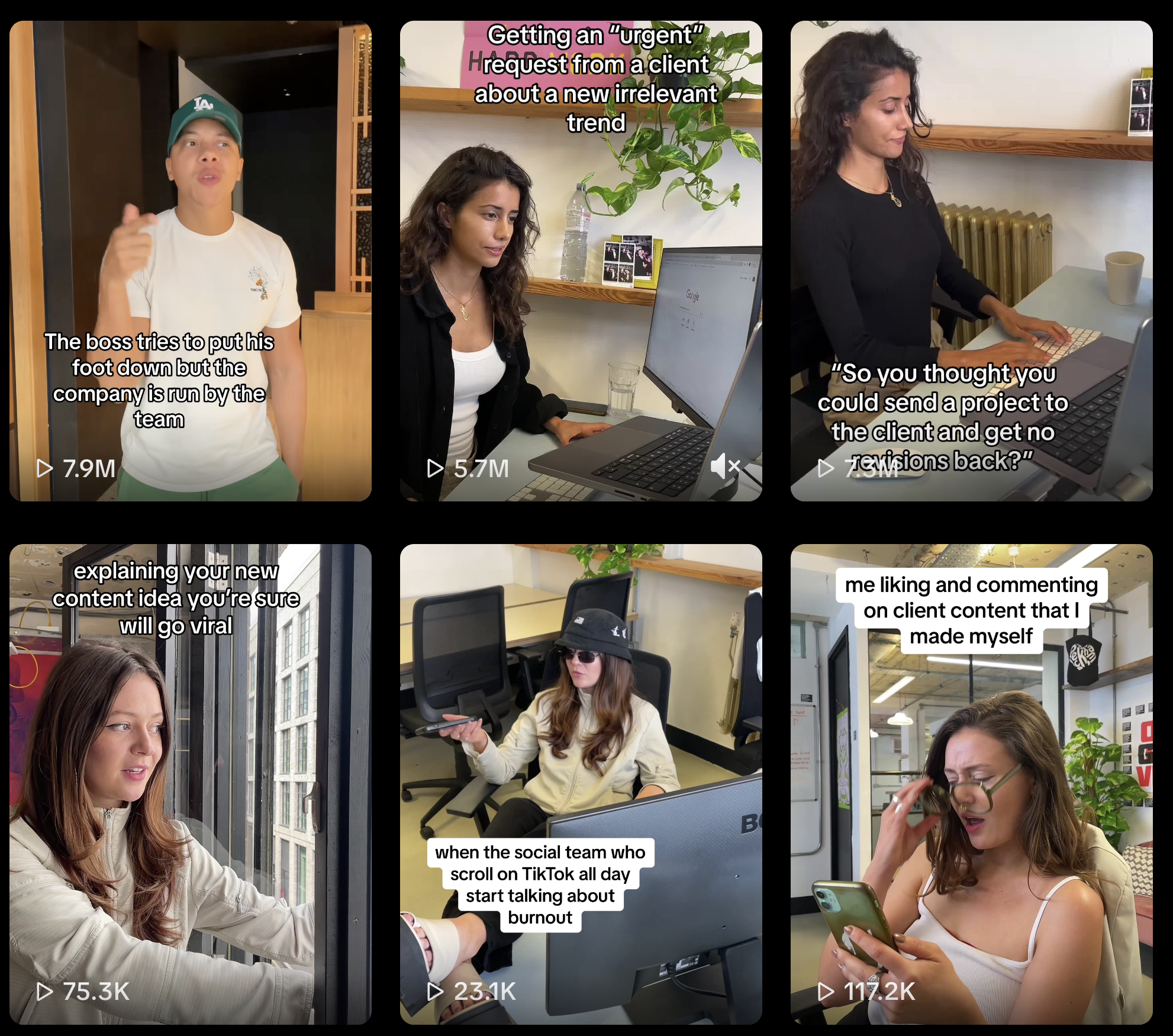
One person can cover multiple roles early, but the functions need to exist as separate disciplines with separate quality standards. The skit format on TikTok works because it can be used to dramatise problems every operator in a particular space has felt but rarely articulated. An editor focused on the cut is not simultaneously thinking about scroll-stop mechanics and funnel stage. When those responsibilities collapse into one person without explicit frameworks, the output can be technically polished and strategically incoherent.
Running a multi-account constellation compounds the need for role clarity. Take fan page architecture for example... different accounts can specialise, one on frameworks, another on founder war stories, another on product demos, but that kind of specialisation requires someone in the distributor role who understands platform-level behaviour. Without that, you post the same cut everywhere and wonder why LinkedIn audiences respond differently to TikTok ones.
The economics that keep clip farms competitive
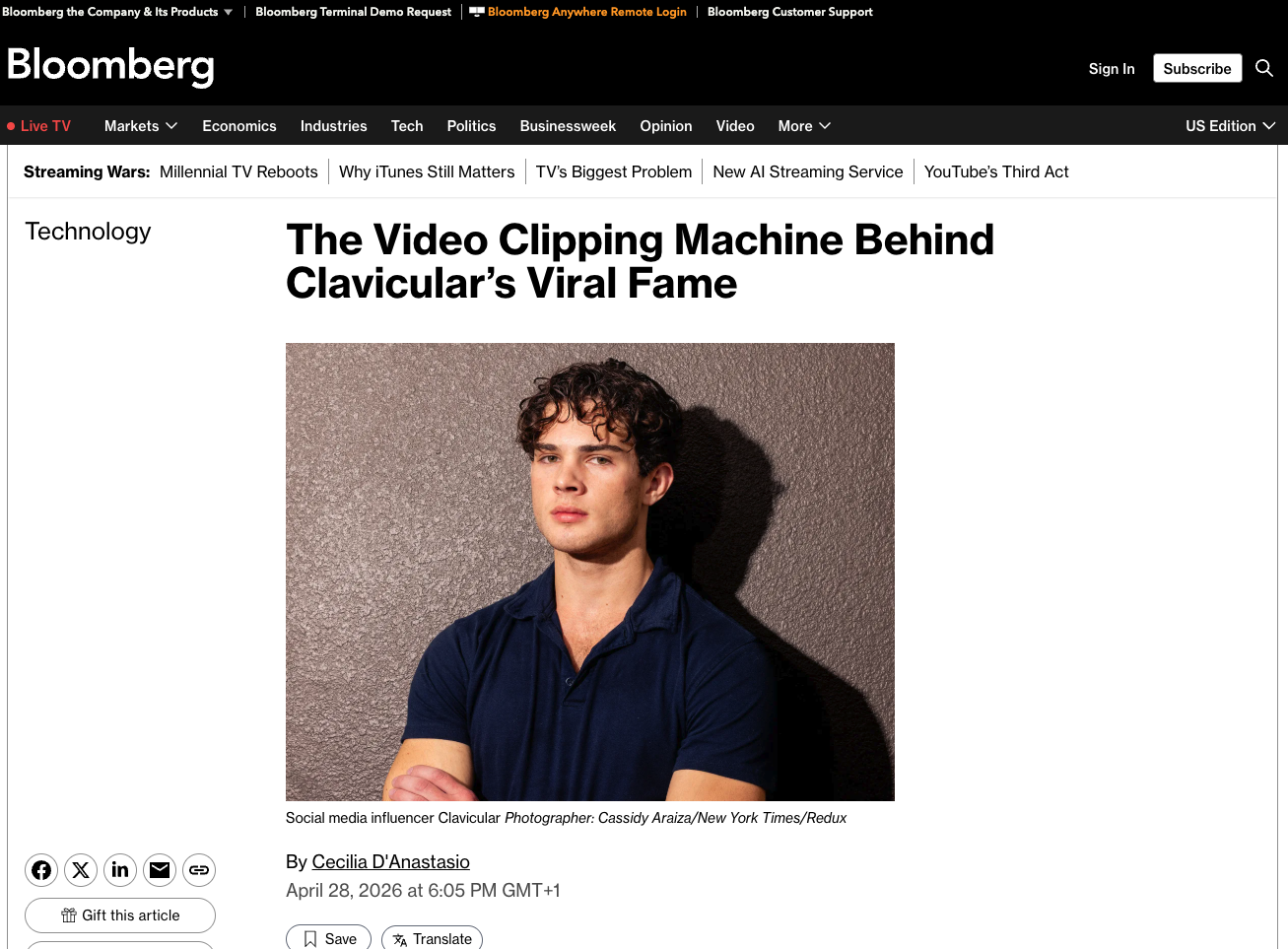
Bloomberg put typical clipper earnings at "a few hundred dollars per million views." On first read that sounds modest. On second read, it explains why clip farms keep appearing. This is a performance market. Good clippers, people who can reliably package attention in ways that generate views, can earn meaningfully, and the brands paying them get distribution at a fraction of what equivalent CPMs would cost. The incentive runs in both directions, which is why the model compounds. When we think about building a clip farm for a scale-up, the Bloomberg figure is the anchor. You build tiered incentives around it, base payout per qualified view bucket, bonus tiers for clips that drive measurable downstream actions like profile visits, email sign-ups, or demo requests, and clear penalties for rule breaks covering misquotes, prohibited claims, and off-brand language. View-based incentives align clipper behaviour with output. They also create a natural filter, clippers who can't generate views don't stay in the programme. The operational layer around that incentive structure is what separates a clip farm from a content mill. The onboarding infrastructure for the programme includes a one-page voice and claims policy, a gallery of ten approved examples, and a banned list covering topics, phrases, regulated claims, competitor mentions, and pricing promises. Clippers submit a raw cut plus proposed hook, caption, and intended platform before anything goes live on owned channels. Treat a clip farm like an affiliate programme and it works. Treat it like a Fiverr order and you get sensationalist content that burns trust faster than it builds reach.
Views are a leading indicator, not the goal
Sort your last ten clips by profile actions per view rather than raw views. The rank order will be different. Sometimes dramatically so. Every team I've watched start a clipping operation optimises for views in the first three months, and I understand why, views are immediate, visible, and create a sense of momentum. Views from content that doesn't create downstream intent are just reach you've rented temporarily. The scoring hierarchy runs in order of what you can actually act on. Early retention tells you whether you stopped the scroll. Average watch time and completion rate tell you whether you repaid the attention you borrowed. Rewatches and loops tell you whether you created something people find worth repeating. Profile actions per view tell you whether the clip created intent. Downstream conversion, where it's trackable, tells you whether any of this drove sign-ups, demos, or purchases.
A post showing a subtitle A/B test dashboard with annotated retention curves, which pulled 1.2K likes on X, demonstrates why seeing this in data form changes how you approach subtitles entirely. You can see a retention cliff in a graph in a way you can't feel it in view counts. We test subtitle formats the same way we test ad creative, word-by-word versus sentence captions, highlighted keywords versus plain text, centre-screen versus lower third, "open loop" first lines where the caption appears before the audio lands. One variable at a time. Run to meaningful view counts. Measure retention differential. Improvements of 20-30% from a single subtitle change are not unusual. When a clip wins across those metrics, the response is decomposition. Hook structure, pacing, subtitle style, shot change frequency, tension curve, CTA placement. That decomposition becomes the brief for the next production batch, and that's when a content operation starts behaving like a learning system.
A high-performing clip posted once is wasted
If you produced paid creative that demonstrably stopped scrolls and created intent, would you run it once? In performance marketing, nobody would accept that. You'd rotate it across audiences, adjust the copy, test it on different placements. With organic clips, teams accept it constantly. The distribution system we run has three layers. Format remixing takes the same underlying moment and produces multiple edits - different hook, different subtitle approach, different crop. Channel remixing routes variants intentionally - the framework cut goes to LinkedIn, the shock cut goes to TikTok, the proof cut goes to Shorts. Comment seeding is the third layer. Pre-write the first five comments. Pin the best one. Use the comment section to direct the next clip and let the audience signal what they want to see next. That feedback mechanism connects to something broader. What you learn from clipping at volume, like... which objections are real, which promises resonate, which words cause drop-off, which proof people trust, belongs everywhere else in the funnel. Landing page headlines. Paid ad angles. Sales scripts. Product positioning. When you ship 50 to 200 clip variations in a week, you're running the fastest and cheapest market research programme most startups have ever run. The teams that compound don't leave those learnings in an analytics dashboard. They feed them back systematically into go-to-market.
Where clipping goes from here
Several things are becoming clear about where this is heading, and I have a view on most of them. The bar for hook quality is rising. As more brands and creators run hook thesis frameworks, "uncomfortable first" and "open with the objection" stop being differentiators and become table stakes. The teams that will win in 18 months are testing second-order hooks, formats that feel genuinely native to specific platform cultures rather than just technically competent at stopping a scroll. Clip farms will consolidate. Right now there's a lot of fragmented, ungoverned clipping activity. As brands get burned by off-brand clips and platforms tighten policies on repetitive content, the clip farms that survive will be the ones with proper QA, tiered incentives, and submission workflows. The Bloomberg-cited economics will bifurcate, lower payouts for commodity clipping, higher for clippers who can demonstrate downstream performance and operate cleanly within programme rules. The multi-account model will attract more scrutiny from platforms. I'd back the teams building governance before they need it rather than after their first strike. Clipping as an R&D input for full-funnel teams will also become standard. Landing page copy that derives from high-performing clip hooks. Paid ad angles that originate in organic testing. The social profile at 150K subscribers isn't just an audience, it's a testing environment for messages that eventually appear across paid, email, and sales.
My honest take is that the biggest opportunity right now is for companies (B2C or B2B) that have founder-led content and no clipping infrastructure. The footage exists. The authority is already there. The distribution system isn't built. That's where I'd focus in 2026.