

Fifteen hundred ads live and twenty-six doing the work
On 7 October 2026 Wispr Flow had 1,549 ads live on Meta. The typical one reached 78 people in the EU and most die inside ten days. Twenty-six have reached 100,000 people or more, and the top tenth of the account takes 94% of the reach. That ratio looks like waste until you read it as a search, and the search is the thing to copy.
The ad count is the cost of the search
I use Flow myself, and I kept seeing its ads, often enough that I left myself a note: "Wisprflow 100 ads on paid on meta. How they grew so fast." A hundred was an undercount by a factor of fifteen.
Honestly, the headline number flatters the picture. 805 of the 1,549 live ads have reached fewer than 1,000 people, and the top 10% take 94% of the reach.
So the account is 26 ads doing the work and 1,500 auditioning for it.
The timing says what kind of audition. 79% of the live ads started on or after 28 September, and 589 of them went live in a single batch that day. The account is run as a weekly intake with the auction as casting director, and 28 September was a Monday.
The mechanism is the thing Meta changed under everyone's feet. Since Andromeda the creative is the targeting. The retrieval layer takes billions of eligible ads and narrows them to roughly 1,500 candidates per impression, so an ad with a weak hook never reaches the bidding stage at all. Audience settings used to be where a media buyer earned their money. Now the only lever that moves delivery is how many distinct creatives you hand the system and how different they are from each other. 1,549 is what feeding that system looks like with money behind it, and the money came from a $280M Series B at a $2B valuation on the back of revenue up more than 30x year on year.
Read 94% as a reach curve and the next batch writes itself. Most of the 589 launched on 28 September will never reach a thousand people, and that is the price of the two or three that join the 26. I think the top-10% share rises towards 97% as the batches get bigger, because the auction gets better at ignoring the losers faster than the team gets better at briefing them.
Ten days is a test, and the test has a scorecard
The median live ad has run for ten days. A third have run for seven or fewer. Before the August round, half the ads were still running past day 20; since the round, half are dead by day 11. Most boards expect a raise to buy a creative a longer run; here the money arrived and the ad life halved, from day 20 to day 11.
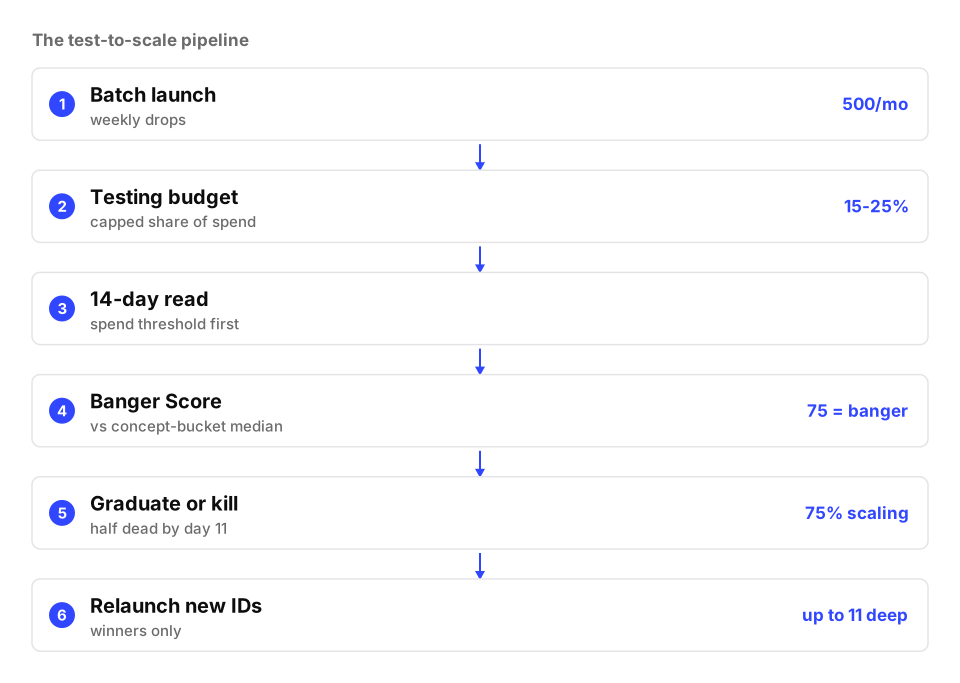
The relaunches are the tell that this is deliberate. 541 pieces of copy have come back more than 30 days after they first ran, across 2,462 ads, and Ali Abdaal's "Stop Typing to Your AI" went out on 14 separate dates between February and September. That is a winner relaunched under new IDs. A fresh ad ID resets the auction's read on the creative and buys it another run before frequency catches up, and that one has had the run 14 times.
Our rules at scale are the same shape. 15 to 25% of spend sits in testing and 75% goes to ads that graduated. We hold an ad 14 days and a minimum spend before a verdict, because a seven-day read on a $12-a-month subscription is noise. Wispr kills faster than that, half its ads by day 11, and at 1,500 live ads it can afford to be wrong about a few. Below a million a month I would not copy the speed. And the work splits roughly 80% creative ops and 20% media buying, which is why one media buyer can hold a $6-10M-a-month account on their own.
Wispr scores every ad on hook (30%), hold (30%), click-through (25%) and CPM efficiency (15%), normalised against the median ad in the same concept bucket, so a messaging ad is compared with messaging ads. 50 is average, 75 is a banger, and the top ads score over 80.
Raw hook rate rewards whichever concept is easiest to stop a thumb on. The bucket median removes that advantage, so the leaderboard ranks execution. A team that copies the weights without the bucketing has a dashboard that ranks concepts, and the weights are the easy part to copy: 30, 30, 25, 15.
What the ads say when fifteen hundred of them talk at once
| Copy angle | |
|---|---|
| Accuracy | 36% |
| Messaging | 31% |
| Speed | 26% |
| Notetaker | 24% |
| 4x faster | 9.7% |
Creators are the supply chain and a marketplace is the warehouse
858 of the ads carry the paid-partnership label. 623 run under 24 creators' own names, and three of those handles alone carry 287 ads: brentvonn with 100, Brown Chronicle with 99, The Diary of a CEO with 88. 3,763 ads carry a creator-marketplace tag in the URL with 1,513 distinct values, which means the briefing, delivery and tracking of most of this account runs through a marketplace.
The placements are Facebook on 100% of ads, Instagram on 99.5%, Threads on 98% and WhatsApp on 73%. Audience Network is not on the list at all. It ran on every Wispr ad in February and on none by July, so somebody switched it off and kept it off.
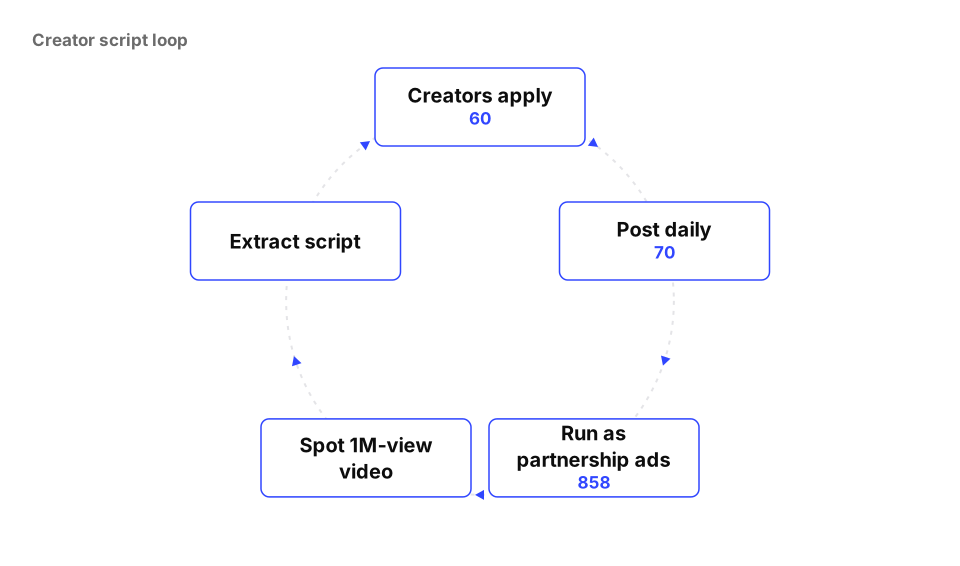
Behind the account sit 200 to 250 active creators making three to ten videos a week each. Under the paid layer is an organic one that feeds it: 1,000 creators applied to the UGC programme, 60 were picked, 70 now post daily, and the programme hit 500 million views in 60 days. It was built by a 19-year-old who had been making content for three months. The rule that makes it compound is the script extraction. The moment a video passes a million views in its first day, the script is pulled and sent to every creator on the roster.
Why it works in platform terms is simple. A partnership ad runs from the creator's handle. The auction reads the handle, the feed treats it as a person, and the same creative pays a CPA that runs multiples below the brand page. Partnership ads also became the required format for any branded creator content in paid this spring, so there is no version of this that stays off the label.
Their result is 75% of the top eight ads being creator UGC and CAC down 54% in a quarter, anchored by the shift from statics to UGC.
My view is that UGC is a totally commoditised scale channel now. Anyone can buy 200 talking heads. The edge is the casting, the brief and the tracking taxonomy that joins 1,513 marketplace tags back to a CAC, and that is bodies, two or three people whose whole job is the roster. At this volume the creator relationship belongs to the creative ops lead, and the media buyer should never be the one talking to a creator.
The creative, frame by frame
72% of the ads are video, 23% dynamic creative, and 96% of the video is vertical. The median file runs 26 seconds. 65% of ads have a caption on screen at 0.3 seconds, sitting at 40% of frame height, which is the one placement that survives both the Reels safe zone and sound-off viewing. Across 5,635 ads there are 1,990 distinct pieces of copy and 1,893 distinct videos.
The best hook-rate ad one week stopped 39.5% of viewers, and 3.6% of them finished it. That gap is why hook and hold each take 30% of the score; a hook without hold is a thumbnail.
"Correcting yourself mid-sentence" and accuracy carry 36% of ads, messaging in Slack, iMessage and DMs carries 31%, and speed against typing carries 26%. The accuracy angle wins because it shows the product failing to fail. A creator rambles, changes their mind halfway through and the text on screen comes out clean, which is a demonstration, and demonstrations outperform claims in every account we run.
Then the loose end. 3,918 of the 5,635 ads point at the plain homepage and 955 at the Notetaker page. A Slack-angle ad landing on a generic homepage throws away the match between the hook and the page, and in our experience that match moves conversion rate by double digits for the cost of a few landing variants. I would build six and route by angle.
The verdict is that the talking head is the commodity here. The caption position, the bucket-normalised scoring and the script-copying rule are the craft, and those three are what the 26 winners share.
Google catches what Meta finds
Google Ads is the main driver in this account, and the traffic series shows why. Paid search traffic went from 19,000 visits in April 2026 to 240,000 in June, with estimated cost moving from $15,000 to $170,000 a month. At the June peak the homepage alone held 2,654 paid keywords and 3,394 distinct ads, including "zoom download" in the UK and a competitor play on Otter AI worth about 23,000 modelled visits to the homepage and pricing page.
By October the account had pulled back to 178 paid keywords and 44 paid pages.
Read those two accounts together and they are one system. Meta creates the demand with the weekly batch, the demand turns into branded and adjacent queries a week or two later, and Google catches it at a fraction of the CPA. The Google spend follows the Meta batches because that is where the search volume comes from.
The June spike is the part I would not have run as long. "Zoom download" buys reach, and the Notetaker launch made it tempting, but a person who wants Zoom does not want a dictation tool yet, and a Smart Bidding campaign fed that intent learns the wrong customer. The October account looks like the one I would run.
Branded search nearly tripled in the five months after Android launched
| Month (2026) | |
|---|---|
| Jan 2026 | 23100 |
| Feb 2026 | 34100 |
| Mar 2026 | 42100 |
| Apr 2026 | 49600 |
| May 2026 | 61300 |
Since the round the ads say Notetaker
The first Notetaker ads went out on 5 August, the $280M round landed on 17 August, and four days later 330 ads went live in one day. August took 1,642 new launches and September 1,465, and by the end of August the account had shipped more new ads in that one month than in the previous five combined. Notetaker or meetings is now the angle in 24% of ads and has 955 ads pointing at its page, while "4x faster", the line on every page of the website, is down to 9.7%.
The strategic read is the useful bit. A Series B funds a second product, and a second product needs a message nobody has found yet. The ordinary way to find one is a positioning workshop and a quarter of waiting. The way this account finds one is 330 ads in a day, scored against each other by Monday week.
By October the Notetaker ads had a named target. 45 of them send people to a Granola-switch page that offers to cover whatever a user has left on a paid Granola plan. Naming the rival and paying off the switching cost in the same ad is the most aggressive thing in the account, and it is the ad I would have written first.
I think Notetaker overtakes accuracy as the top copy angle within two quarters, because a meeting is a sharper moment of pain than a typo, and I think the live-ad count halves as the account consolidates around it. Fifteen hundred live ads is a search; once the search has found a message, the roster narrows and the batches shrink.
India got autorickshaws and the rest of the world got the app stores
More than half of Wispr's users sit outside the US, and the traffic shows it. India produced 39,837 modelled organic visits against 41,556 in the US, and 14% of global downloads from October 2025 to April 2026. The Android launch on 13 February 2026 did roughly 85,000 US downloads in its first full month, and iOS US downloads ran 37,000 in October 2025 to 128,000 in December.
In Bangalore the move went physical: 100 autorickshaws wrapped in Flow branding driving laps of the city, a placement on the screen twenty million Zepto users watch while their groceries arrive, and Zepto's top 100 leaders on Flow for a year.
OOH in a city where the product already spreads by word of mouth is reach the auction cannot sell you, and a hundred autos is a cheap test. That is the only reason to run it. I would measure it on branded search in Karnataka against two control cities over eight weeks and nothing else.
The Head of Growth job spec asks for two new channels or geographies taken from zero to scale, which tells you India was one of them.
The affiliate layer pays 25% for a year and nothing up front
The partner programme runs on Dub, with thousands of active partners and roughly 4x average ROAS. The standard reward is 25% revshare for one year. On top sit bounties: $500 for referring 100 new customers, $250 per 1,000 views on a YouTube video, $300 for a blog post.
The YouTube bounty is the same creator supply chain as the Meta account, paid on a different meter. On Meta a creator is paid for the asset, on YouTube per view, and on revshare per customer. Three meters, one roster. The blog bounty explains part of the referring-domain series, which went from 260 in January 2025 to 11,024 in October 2026 with 2,756 added in September alone.
Now the cost. Pro is $12 a user a month billed yearly, so 25% for a year is $36 a customer, paid only when a customer exists. Against a paid-social CAC that is a cheap customer, and the ROAS proves it. The catch is that revshare recruits partners who already have the audience, and a programme that pays nothing up front finds nobody who does not. I would keep it exactly as it is and never expect it to be the first channel anywhere.
What to copy at $50k, $500k and $5m a month
This is our standing method, and Wispr is the proof it holds at the top end.
| Monthly media | Creators on roster | New ads a month | Testing share | Who runs it |
|---|---|---|---|---|
| $50k | 8 to 12 | 40 to 60 | 15 to 25% | One buyer who also briefs |
| $500k | 40 to 60 | 150 to 250 | 15 to 25% | One buyer, two creative ops |
| $5m | 200 plus | 500 plus | 15 to 25% | One buyer, a creative ops team, a marketplace |
The thresholds under the table are ours at every size. An adset needs roughly 50 conversion events a week to leave learning, so daily budget is set backwards from CPA: at a $20 CPA that is $20 times 50 over 7, about $143 a day per adset, and anything below it is Learning Limited by design. A channel gets two or three iteration cycles over two to three weeks before a verdict. Creative production spend matches media spend in the first months. Partnership ads are a minimum of 30% of the account. AI video sits at around 5% of the mix, because past that the feed can tell a machine made it.
500 ads a month and 200 creators is the top tier only. What transfers is the structure: a scorecard, a bucket median, a 14-day read and a weekly batch.
The operating point for a CMO is the middle row. At $500k the briefing, tracking and killing is already more than one media buyer, and it is the discipline most teams try to staff with one hire and a marketplace login. It takes three people, and the two creative ops seats are the ones that take a year to get good.
What not to do with this
Do not scale spend before CAPI and the conversion event are wired. Most companies skip it, the match rate sits at half what it could be, and the auction optimises on ghosts.
Do not cut the account to the 26 winners. The 1,500 losers are the auction's shortlist, and once an audience has seen a creative three to five times CTR falls and CPMs rise. Cut the losers and the winners inherit the frequency.
Do not hand Advantage+ the budget unwatched, and do not switch Audience Network back on because the placement default offers it. Wispr's placement list stops at WhatsApp, and that is a choice.
Do not run talking-head UGC into branded search or warm retargeting. A person who already searched for you wants the product, and studio still wins there.
Do not read ten-day ad lives as waste on a dashboard. Most of those ads were ignored by the auction after a few dollars, and the ones that took real spend are the ones relaunched under new IDs again and again.
And do not build the 200-creator supply chain in-house before the channel has paid back once. It is a year of hiring and a year of mediocre output, and the marketplace plus a creative ops lead gets you to the first payback faster.
Copy the rule that pulls the script from any video past a million views in a day and sends it to every creator by the evening. It costs nothing, it needs no budget sign-off, and I think it is worth more than the media buyer.