
The mobile app failed, so growth moved to the desktop and the feed
Honestly, the first version of this business was a flop. Diffuse, the iOS app, peaked at 24,633 US downloads in August 2024 and was down to about 2,000 a month by January 2025. The mobile app had reached a million users in two months and the retention told the team to stop. The desktop product launched on 31 March 2025, and every number below counts from that date.
What took off was a creative decision dressed as a product one. A preset is a hook. Somebody scrolling X sees the crash zoom or the bullet-time orbit before they know which tool made it, and the only question left in their head is which tool made it. That question is a brand search, and we'd kill for ad creative that generates it unprompted, because most ad creative shows the product and asks for the click and the internet simply scrolls on by. One-click visual effects took the company to $10M ARR in about six weeks, and the library now runs to 400 camera-motion and effect presets.
The cadence is the other half of the engine. A launch every four or five days is a reason to post every four or five days, and that is what the creator machine gets fed with. Higgsfield ships six days a week, more than 300 releases a year, and in its first eight weeks put out twelve major updates, each with its own media kit, influencer push and launch campaign.
Credits are the social currency that pays for the posting. 300 credits by DM for a retweet and a reply. Five credits for a follow, like, retweet and comment, open for twelve hours. Every one of these is a paid post by another name.
Demand followed. Organic visits to higgsfield.ai went from 61 in March 2025 to 424,000 in July. Brand search across six markets went 1,400 to 58,600 to 577,000 a month, then spiked to 4.5 million in July across every market at once. The /motion preset pages went from 1,100 visits to 45,500 between July and August 2025.
Three programmes and one supply chain of posts
Three programmes, one output. Each buys posting from a different kind of account, and the cheapest line item in all three is the label.
| Programme | Who it is for | What it pays | What it asks |
|---|---|---|---|
| Higgsfield Earn | Creators of any size, in regions on an allow list | Guaranteed payouts, advertised at up to $100,000 a week | Post inside the campaign window, pass automated verification, keep all comms confidential |
| Creator Partnership Program | Established creators | A full plan renewed monthly, extra credits, models before release, individual Earn campaigns on top | Tag or mention Higgsfield, stay engaged with launches |
| Affiliate programme | Anyone with an audience | Up to 25% commission for 12 months | No paid ads on the link, no brand bidding, no coupon or cashback sites |
Earn is the one to study because it is built like a supply chain. Verification is by email or a code in the bio, per platform. Promo codes are assigned to one creator and can't be transferred. Submissions go through an automated content verification system that rejects purchased views, incentivised interactions, click farms and anything posted outside the window, with no manual review. Every check on that list is about whether the engagement is real. Whether the post says it is paid sits on a consent checkbox the creator ticked before seeing the campaign.
The affiliate link is wired for urgency. The referred buyer gets up to 50% off, live for three hours from login, and the programme's own worked example is ten referrals a month at $100 each at the top 25% rate, $19,500 over twelve months.
Scale is the number that matters. Earn paid out $800,000 to more than 10,000 creators in three weeks; in its first 20 days it commissioned 10,000 creators who submitted 50,000 videos. That is $16 a video, which is clipping-marketplace money for a post from somebody who reads as a fan. On top sits more than $3 million in free credits and $200,000 in contest prizes.
The launch window is the mechanism, and it works from twenty followers
The launch burst is the best piece of work in this story and I'd copy it tomorrow. Six of the twelve releases between March and June 2026 ran through a creator-launch agency as full launches, and the method fits in a paragraph.
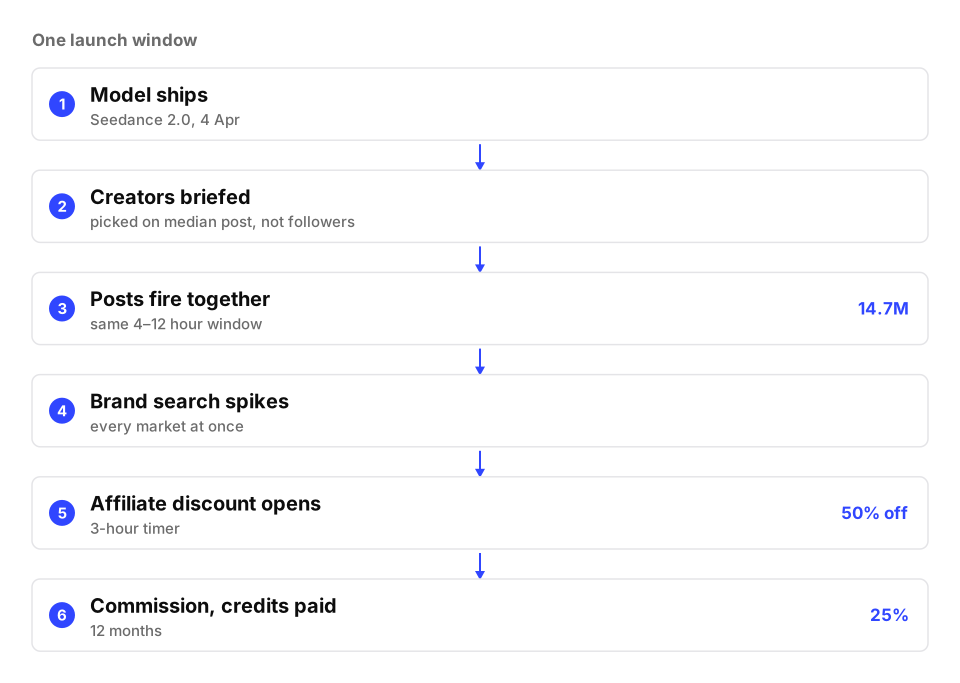
Creators were chosen on median post performance and on audience overlap with the buyer: people who edit video, build with AI tooling or sign off purchases of creative software. Follower count was ignored, which is right, because it is the least predictive number on the profile. Each creator got a brief and wrote their own copy. Posts fired inside the same four-hour window, some stretched across eight to twelve.
The Seedance 2.0 launch post did 14.7 million views from an account with 137,000 followers, 108 times its following. The two April drops carried 24.8 million of the 31.1 million views across the six launches. A founder-led post from a personal account with 20 followers reached 1.1 million.
The window works because the feed ranks on early velocity. Fifty posts about one thing inside four hours reads to the ranking as an event, each post lifts the others, and the replies and quotes pile into the same hours. Then the rest of the stack lands in the same hours too. The affiliate discount runs for three hours from login. The credit giveaways run for twelve. The brand search spike in every market at once is what the window looks like from the outside. Half of a year's posts falling in 9% of the hours is engineered, and I'd engineer it the same way.
Where I part company with the work is the copy. Own copy from a briefed creator is the whole reason the format reads as a person talking, and about 2,700 of this year's posts show what happens when the brief gets pasted instead.
Launches drove the posting and almost none of it was labelled
Half of a year's Higgsfield posts on X landed in 67 of 730 sampled hours, which is a launch calendar showing through the feed. Across 6,128 sampled posts, 200 carried any disclosure label. Buy posting in windows like that and the window is the campaign, so every unlabelled post inside it is the brand's problem.
Five sentences, 700 accounts, under one label in a hundred
We counted a year of X. About 73,500 original posts mentioned Higgsfield in the twelve months to October 2026, replies, staff and the company's own accounts excluded.
The volume comes from a small, persistent group. 45 accounts posted in at least six of thirteen months. The 20 most frequent posters wrote 4,572 posts with 100.8 million views between them, and 2.7% of those posts carried any kind of label. Accounts that used #higgsfieldpartner at least once wrote 42% of everything we sampled.
Labels across the whole year: 1,902 labelled posts from 601 accounts, about 2.6% of estimated volume. 1,418 of those fell in February 2026 alone, the month the hashtag ran. Leave out the week of 4 to 10 February and labelling is 1.6%. Count only standard labels, #ad or paid partnership, and it is 0.8%.
The pasted brief is the part I'd have stopped. "Granted FREE access to Google's Nano Banana Pro" appears in 1,628 posts from 165 accounts. "Biggest price drop in the GenAI industry" appears in 253 posts from 234 accounts. "Marketing Studio powered by Hermes Agent" appears in 221 posts from 207 accounts. Across five identical campaign phrases that is about 2,700 posts from about 700 accounts, 22 of them labelled. Identical copy across hundreds of accounts is a brief that was pasted, and a pasted brief with no label gate is an operating failure before anybody opens the Endorsement Guides, because it is also the easiest pattern on the platform for a reporter or a classifier to find.
Other surfaces tell the same story at a different rate. On YouTube, 118 of 526 third-party Higgsfield videos carry the paid promotion flag, 22%, which is what a creator does when the platform puts the toggle in the upload flow. The Meta Ad Library holds 18,173 ads mentioning Higgsfield and not one of them is Higgsfield's. The paid reach on Meta belongs to creators, course sellers and contest entrants boosting their own posts.
A label count is a count of what is visible. A missing label is a disclosure gap, and that is all I'm calling it.
The #higgsfieldpartner hashtag ran 481 posts a day then died suddenly
| February 2026 | |
|---|---|
| 5 Feb | 481 |
| 6 Feb | 245 |
| 7 Feb | 108 |
| 8 Feb | 340 |
| 9 Feb | 113 |
| 10 Feb | 8 |
A hundred accounts carried three quarters of the views
| Accounts ranked by views | Share of posts | Share of views |
|---|---|---|
| Top 10 | 6% | 36% |
| Top 25 | 12% | 49% |
| Top 100 | 32% | 78% |
What is on the record, and what creators say happened
Two columns, and I'll keep them apart. On the record first.
The main X account, almost 200,000 followers, disappeared around 9 February 2026 with no public explanation from X, and posted nothing between 7 February and 4 May. The CEO's public statement put Earn payouts at $800,000 to 10,000 creators in three weeks. One creator was offered $200 to share a post and a clip. The company itself has said it shut 40,000 accounts for bot activity in December and January, refunded $1.35 million to genuine users hit by slowdowns, gave away $3 million of promo codes, and that 90% of Earn submissions were paid. In August 2026 Matti Haapoja and Sam Kolder, two of the best-known filmmaking YouTubers, posted videos on Seedance 2.5 with no ad label, and the company confirmed they were paid in money and credits. Asked about the controversy on 20VC in September, the CEO said the company had "just a team of like two people on creator and customer success sides", "did outsource to the agency", an agency he did not name, and that it "was not a good experience". In July 2026 a terms change went out, a thread about it reached 331,000 views, and a revision landed within three days with the training grant word for word unchanged.
Then what creators say happened. Per-post offers ran from a few hundred to several thousand dollars. One YouTuber was briefed at $30 for a seven-minute video with a 24-hour deadline, delivered it on 2 December and was still unpaid two months later. Others posted screenshots of offers from PR firms working on the brand's behalf. Users reported a 19 December outage, simultaneous generations on unlimited plans cut from eight to four to two, and a $5 unlock on plans already paid for.
Every item in the first column is the machine running as designed. Volume was bought, volume arrived, and the control layer that should have sat between the two was left for the creators to supply. Handing it to an agency moved the work and left the risk exactly where it was.
The FTC bills the brand, whoever did the posting
The rules are short and they all point at the same desk. The Endorsement Guides apply on social media exactly as on television. Enforcement focuses on the advertiser and its agencies. The advertiser is responsible for what its network says on its behalf and is expected to run a reasonable programme to train and monitor it. A disclosure behind a hyperlink or in a previous post is neither clear nor conspicuous. Affiliates must disclose the commission. Agency employees must disclose too. X's own position matches: a Paid Partnership label that can be applied after posting, and a head of product on record that undisclosed promotion makes people distrust the product.
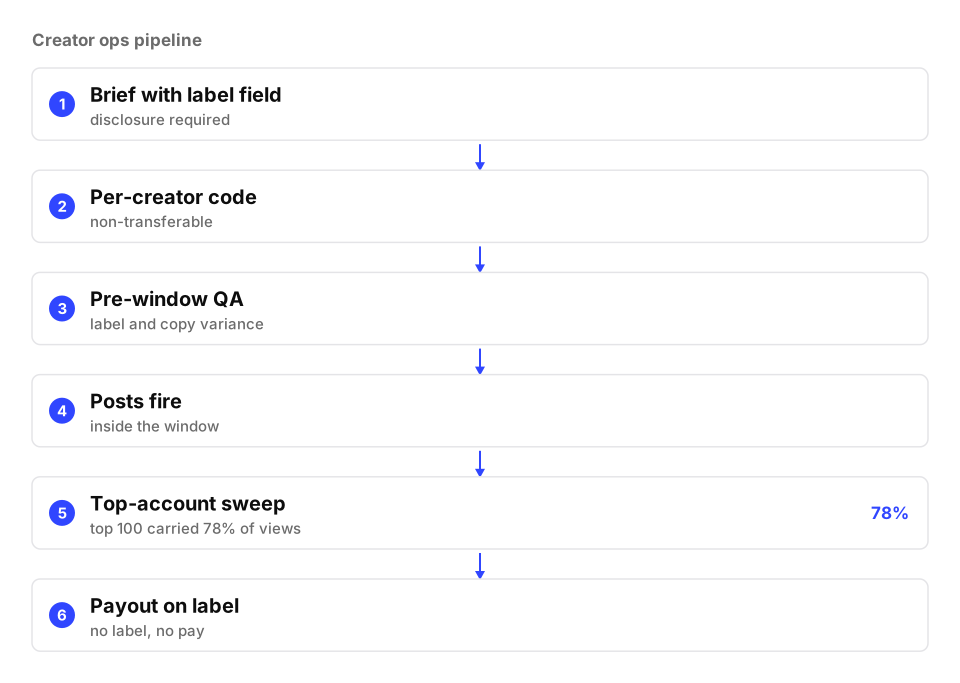
So the posting can be bought from ten thousand people and the risk stays with the brand. We run creator volume on that assumption, and the pipeline looks like this.
- The brief carries the label instruction as a required field, with the exact wording for each platform. A brief without it doesn't leave the building.
- Every creator gets a tracked link or a personal code. Higgsfield already assigns non-transferable codes, which is the join between a post and a payout, and it is the same join you use to find the post.
- QA before the window opens, on label and on copy variance. Five identical phrases never ship, because two posts with the same sentence get one rewritten.
- A monitoring sweep after the window, starting with the top 100 accounts. Here they carried 78% of views, so checking a hundred profiles covers most of the exposure.
- Payout gated on the label being present. No label, no money, and the creator knows that before they post.
- The launch runs from creator handles and founder handles as well as the brand's, so a suspended account costs a redirect and a day.
Cost it honestly. At 10,000 creators and 50,000 videos in 20 days, that is 2,500 videos a day to check, and a label check on each is a full-time operation of several people with a classifier doing the first pass. Automated content verification solves a different problem. It checks whether the engagement is authentic. The label is a separate gate, and here nobody built it.
From $11 million to $1 billion in sixteen months
| May 2025 | 11M |
|---|---|
| Nov 2025 | 100M |
| Dec 2025 | 200M |
| Jun 2026 | 500M |
| Aug 2026 | 700M |
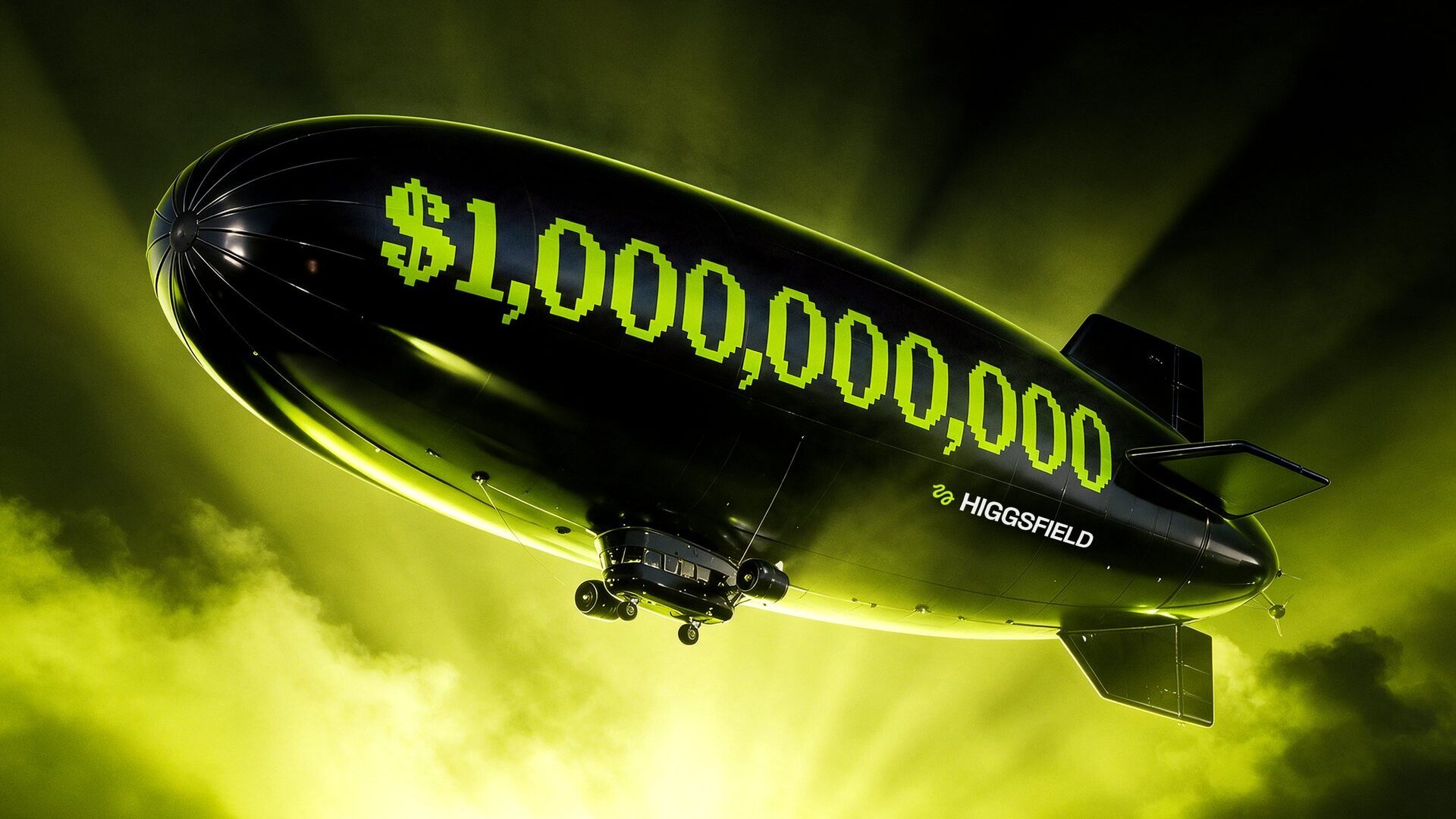
| Sep 2026 | 1000M |
The business the launches built, and what it costs to keep running
Zoom out from the feed and the buyer is a marketer. Roughly 70% of revenue comes from agencies and did from early on. Social media marketers represent 85% of usage, and 80% of them are producing commercial work. Subscriptions are just over 60% of revenue, down from more than 90%, with about 40% on annual, ACV nearly doubling each quarter and 390 of the Fortune 500 on the platform.
The margin is what pays for the giveaways. On its own and open-weights models the margin is over 80%; on closed models it is 20 to 30%. Internal model usage runs over $4 million a month and a cloud migration cut compute cost by 45%. When a free credit costs you a fifth of its sticker price, handing out $3 million of them is a $600,000 decision, and a launch paid in credits is cheaper than it reads.
Retention is the part that makes each launch compound. M1 revenue retention of 86% and NRR over 300% at month twelve sit next to a 30% first-month drop on the consumer side, which is why mobile is under 10% of revenue and why I'd stop reading the download chart entirely. The buyer who stays is the one producing ad creative for somebody else.
The maintenance bill, once the launch budget is spent, is the figure a CMO wants and never gets. $800,000 to creators in three weeks. More than $3 million in free credits and promo codes. $200,000 in contest prizes. $1.35 million refunded. 40,000 accounts shut. A growth team that went from 2 people to 10, with more than half the next ten hires going to growth, and 150 in-house creative professionals making the launch assets the creators post.
The precondition is two things at once. A gross margin that can afford to give the product away, and a release cadence that hands creators something new six days a week. Miss either and you have bought one launch you can't repeat, and one launch you can't repeat is a very expensive month.
What not to copy when you copy this
Copy the preset as hook, the launch window and the credit currency. Then don't copy any of the following.
- Don't treat a branded hashtag as a disclosure. A tag that is itself a promo reads as a promo.
- Don't pay per post with no label gate. The money has to depend on the label, and the creator has to know that before posting.
- Don't paste a brief. Identical sentences across hundreds of accounts are what turned a disclosure gap into a story.
- Don't let the brand's own account be the only voice. The fallback accounts exist before the launch, because three months of silence is what the suspension cost here.
- Don't assume the brand-bidding ban enforces itself. Affiliates were bidding on the brand term in Brazil, Malaysia and Mexico from September 2025. The US brand CPC is $0.10 against $0.90 to $1.60 for rivals, so either police it or buy it yourself, because at ten cents a click it is the cheapest defence you will ever run.
- Don't open creator volume before support and compute can take it. The December caps from eight to four to two generations, and a $5 unlock on paid plans, are what it looks like when the launch outruns the product.
And know what is unavailable at your margin. At a 20% to 30% gross margin a free credit is a real dollar, the $19,500 affiliate example is a loss, and a 50% discount for three hours is a promotion you run twice a year. The play transfers to software and to very little else.
Within a year the unlabelled launch window on X stops being bookable at this scale. The Paid Partnership label can be applied after the fact, which turns enforcement into a search query, and the next company to run this machine will be judged on its label rate before anyone looks at the view count. I think 0.8% is the last time that number gets published without the brand having counted it first.