
The 47% increase that never touched the margin
Revolut increased marketing investment 47% year on year in 2025 "while maintaining strict adherence to our payback period constraints". Revenue rose 46% to $6.0bn from $4.0bn, and profit before tax margin went up, from 35% to 38%.
One line further down the release explains it. Over 63% of new retail customers joined via word-of-mouth or referral, and Revolut added 16 million retail customers in 2025, so roughly 10 million arrived with no media cost attached, and the 47% increase was buying the other six million.
A payback rule policed against a blended cohort is a weak rule. The organic 10 million subsidise every marginal decision, and a channel that is genuinely underwater can hide inside a healthy average for years. On a $6.0bn revenue base with a 38% pre-tax margin, a lot of media can be wrong and nobody notices. Revolut does not publish the absolute marketing number, and that is the one figure that would settle whether the 47% was disciplined or simply affordable.
What the marketing was actually selling
Subscriptions grew 67% to $936m, faster than anything else on this chart, and paid-plan adoption rose 42%. That is what makes an aggressive payback constraint survivable: every acquired customer lands on a surface that reprices them upward within months, so the second and third dollar of revenue arrive without another media impression. With 11 product lines each clearing roughly $135m and the largest stream, card payments, at 22.2% of revenue, a campaign in one market is underwritten by five income lines at once.
| 2024 | 2025 | |
|---|---|---|
| Card pmts | 887M | 1300M |
| Interest | 1000M | 1300M |
| Subscription | 541M | 936M |
| Wealth | 647M | 876M |
| FX | 540M | 800M |
When the product is doing the acquiring
The 63% gets read as a referral programme win. It is closer to a usage number: a product used more often is a product used more often with a second person in the transaction, and each of those puts a Revolut surface in front of a non-customer with a friend's name attached. Transactions per customer rose 24% year on year; total volumes rose 65% to $1.7 trillion.
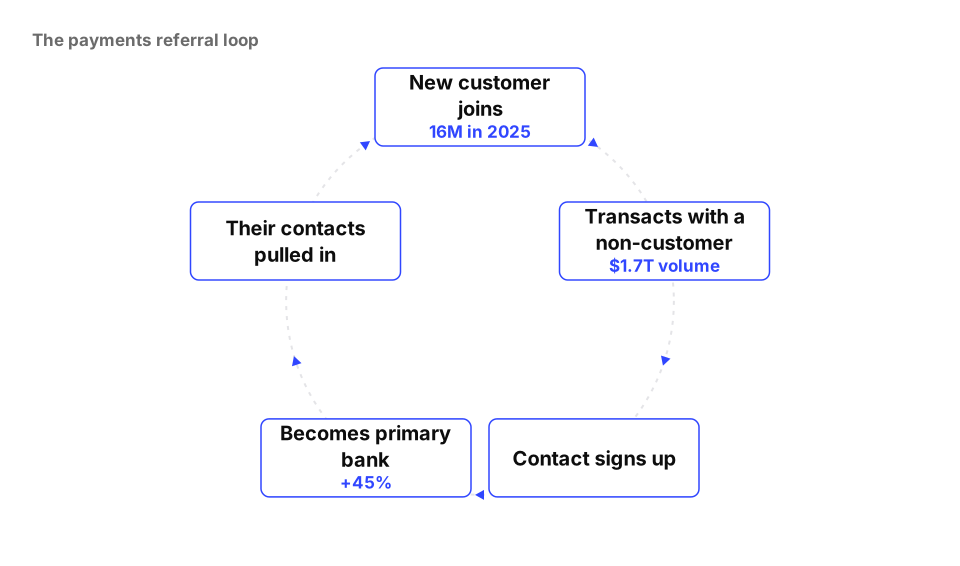
Customers naming Revolut as their main bank rose 45%. A secondary card gets used on holiday; a primary account sits inside the daily contact graph, rent, groceries, the group trip, the sibling who needs $40. Referral loops decay when a user exhausts their contact list faster than they use the product, and Revolut widened both sides of that ratio in the same twelve months: usage up 24% per customer, primary-bank status up 45%.
RevPoints went from 6.6 million users at the end of 2024 to 17 million across 36 markets. Its job is not loyalty, it is keeping the card top of wallet so the transaction volume that generates the invites keeps happening, 17 million enrolled against 68.3 million retail customers.
You cannot buy a product where usage requires a counterparty. If you sell single-player software, no incentive structure manufactures this, and the teams that try end up with a $50 double-sided bounty and a payback period nobody will show you. The transferable version is narrower: find the step in your product that already involves a counterparty and put the invite there, at the moment the second name is already on screen.
Note what the report withholds. It publishes one aggregate referral share and nothing behind it, no cost per activated referral and no split between organic word-of-mouth and paid-out incentive, which is the split you would need before modelling anything against 63%.
The search footprint nobody bought
Revolut spends $85,695 a month on paid search and gets 30,202 visits for it, about $2.84 a click. The organic estate sitting next to it pulls 16.6 million visits a month, traffic that would cost $5.9 million a month to rent, 69 times the paid line, off 637,424 ranking keywords, 219,916 of them in the top three. One page, the currency converter, does 239,671 of those visits. That page is also exactly the format an answer engine strips for parts: a converter that returns a rate is a widget, and the model quotes the rate without the brand. I would hold the search budget flat and put the difference into making the converter and the locale pages cite-able, a named rate source, a dated methodology line, a spread comparison a model can lift with attribution, because FX is the query Revolut owns and it is 239,671 visits a month away from being answered before anyone clicks.
Airports are a targeting decision dressed as brand
Forty-one above-the-line campaigns, 18 new airports across 11 countries, six large-scale sponsorships including the NBA's European games and three sports clubs, and Money Possibilities, the "world of money possibilities" line, running across film, OOH, DOOH, social and audio in more than 20 countries. Read as a list it looks like a brand budget doing brand things. The arrivals-hall takeover is the fintech category's house style by now and most of the category buys it as reach. Revolut is buying intent. An airport is the highest-intent FX environment on earth, and the media sits fifty feet from a bureau de change quoting a spread that makes the core pitch argue itself.

If you cannot name the intent your OOH sits next to, you are buying reach and calling it targeting. That is why the payback constraint holds in a departures hall and would collapse on generic transit or a roadside 48-sheet. The traveller is about to spend money in a currency they do not hold, within hours, and the download is a two-minute action they can finish in the security queue. Same person, same moment, bought in a different auction: the currency-converter page pulls 239,671 organic visits a month off 11,692 keywords, while paid search takes $85,695 a month across 1,222 pages, roughly $2.84 a visit for 30,202 visits, about a million dollars a year against $6bn of revenue.
The B2B side is the harder sell and the one I would interrogate. Sales headcount went up 27% across SMB, mid-market and enterprise, Business grew 53% to 16% of income (call it $960m), and expansion markets in Singapore, Australia and the US grew over 140%. Then the funnel arithmetic: 30,000 companies joining every month is 360,000 gross adds against a net move from 578,000 to 767,000, so something close to half the intake fails to stick.
So the 27% more salespeople are partly backfilling a leaky self-serve top of funnel. If I ran that P&L I would hold sales headcount flat for two quarters and move the money into activation, meaning first payment, payroll connection, first FX run, because a market growing 140% on accounts that churn inside the year stops compounding without warning.
The ladder that pays for the media buy
Total revenue of $6.0bn across 68.3 million retail customers is roughly $88 a year each, of which about $13.70 is subscription. Paid plan adoption grew 42% on the back of what the company calls new partner benefits, which is a price hold with more in the box. They made the top rung denser: instant access savings launched in 21 new countries and balances more than doubled to about $27bn, the lending book grew 120% to $2.9bn, and 45% more customers now treat Revolut as their primary bank.
The margin came from somewhere else. Over 75% of support interactions were resolved by the Gen AI chatbot by year end, retail resolution times fell more than 40% and business more than 50%, while average headcount grew 10% against a customer base up 30% and transactions per customer up 24%. Cost per contact fell and NPS rose 12 points in the same twelve months.
Most companies deploy support AI, take the cost saving and eat a satisfaction hit. If your funnel is 63% word-of-mouth that trade is suicidal, because the support queue is a media channel and resolution time sits upstream of referral rate. Before briefing another piece of creative I would plot referral rate per new customer against median resolution time by market; if the correlation holds, the deflection target has a marketing owner and a seat in the growth review next to the 41 above-the-line campaigns.
The line you cannot copy is Risk and Compliance headcount, up 42% against 10% overall.