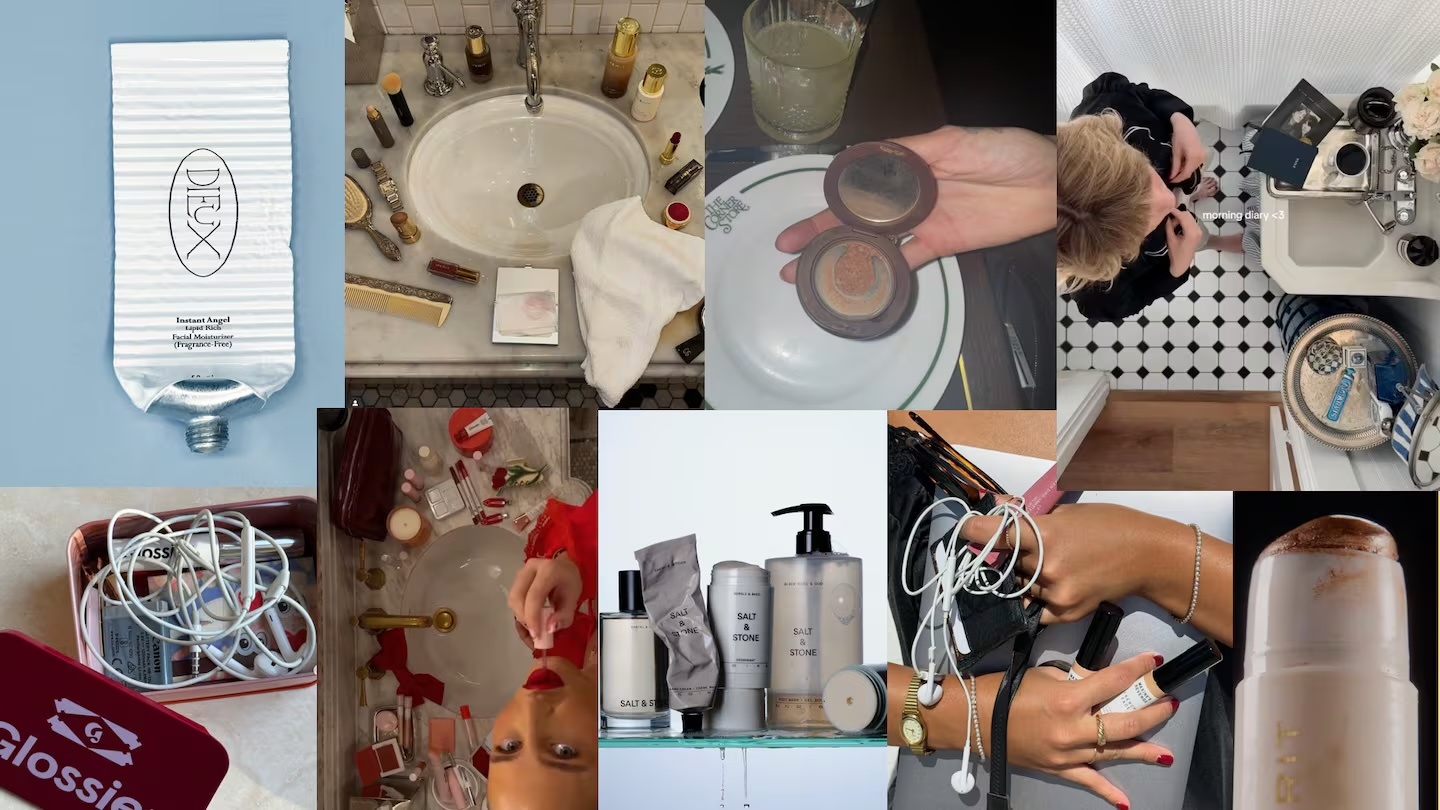
The messy sink shot is a style guide now
Merit's messy sink shots were styled to look like accidents, and for a while the styling worked. Then the comments started reading them as performance, which is what happens to any look once enough brands have bought the same one. The anti-AI aesthetic, the smear, the spill, the flash that was never retouched, is a style guide now, and a style guide can be briefed to a studio or typed into Sora 2. Adam Mosseri has said out loud that Instagram will get worse at spotting AI as the models improve, so the platform's label settles nothing either.
The room knows this and performs the opposite. 67% of marketing leaders say AI-made advertising does more harm than good, and 66% say they feel pressure to appear AI-first anyway. The audience has already priced it in: 68% of US consumers frequently wonder whether what they see online is real, half would rather give their business to brands that keep generative AI out of consumer-facing messages, and 76.6% say learning that a brand uses AI visuals hurts how they see it. The suspicion lands on the work you built by hand too; the chart below is viewers scoring Sora 2 within seven points of a human crew on every measure.
So the brief has shifted. We used to brief work to look real. We now brief it to be checkable, and only where it is going to be checked. The work that gets doubted is a predictable set: surreal premises, practical effects, novelty objects, puppets, miniatures, anything where the first reaction is to wonder how it was done. A straight product shot on a seamless gets no second camera and no behind-the-scenes line in the estimate, and Quip's mouth-headed man on a daybed gets both.
Our rule in the creative review is one sentence. If the first comment you can imagine under the post is "this is AI", the concept gets a second camera on day one.
Viewers put Sora within seven points of human work
| Viewer measure | Human-made | Fully AI (Sora 2) |
|---|---|---|
| Entertaining | 55% | 52% |
| Eye-catching | 56% | 49% |
| Creative | 55% | 48% |
Cut the behind-the-scenes before the hero is approved
A second camera is on set from the first setup and it shoots the things the hero hides: the hands, the headpiece going on, the miniature sitting on the table, the rig holding the object up, the blue screen before the composite. It is a documentary brief, one operator, handheld, rolling while the main unit resets, and it costs one day rate.
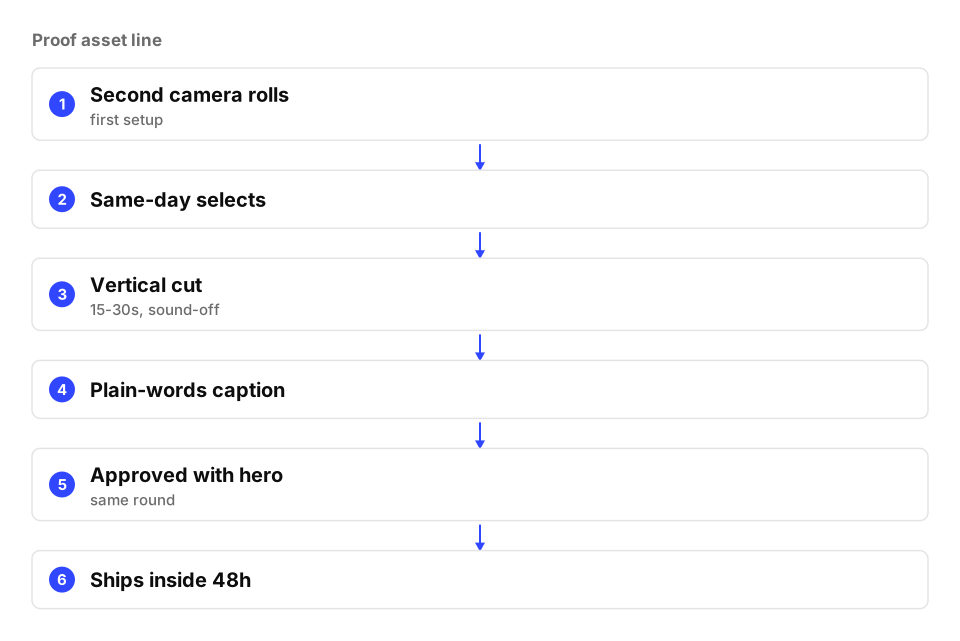
Selects are pulled the same day. The cut is 15 to 30 seconds, 9:16, built to work sound-off, and it opens on its own hook. The hook is the moment that answers the doubt: a hand entering frame to adjust a prop, the actor pulling the headpiece off, a finger pressing a pickle back under the brine. Caption in plain words, five or six of them. It goes through the same approval round as the hero and it is scheduled to ship with it or inside 48 hours.
Cost. A 30-second spot sits somewhere between $30,000 and $100,000 once concept, crew, talent, post and licensing are in, and a shoot planned for multi-channel output already spends 10 to 15% of budget on post-production versioning. The making-of is one extra body on set and one day in the edit, and it decides whether the rest of the spot gets believed. In the shoots we plan it lands at a low single-digit share of the whole production, a thousand or two on a $50,000 spot.
A making-of left to the end of the edit gets cut when the schedule slips, and schedules slip. Ours is fixed in three places before anyone shoots: a line in the estimate, a slide in the approval deck and a date in the flighting plan.
LEGO and Apple launched with the proof and Quip shipped a reply
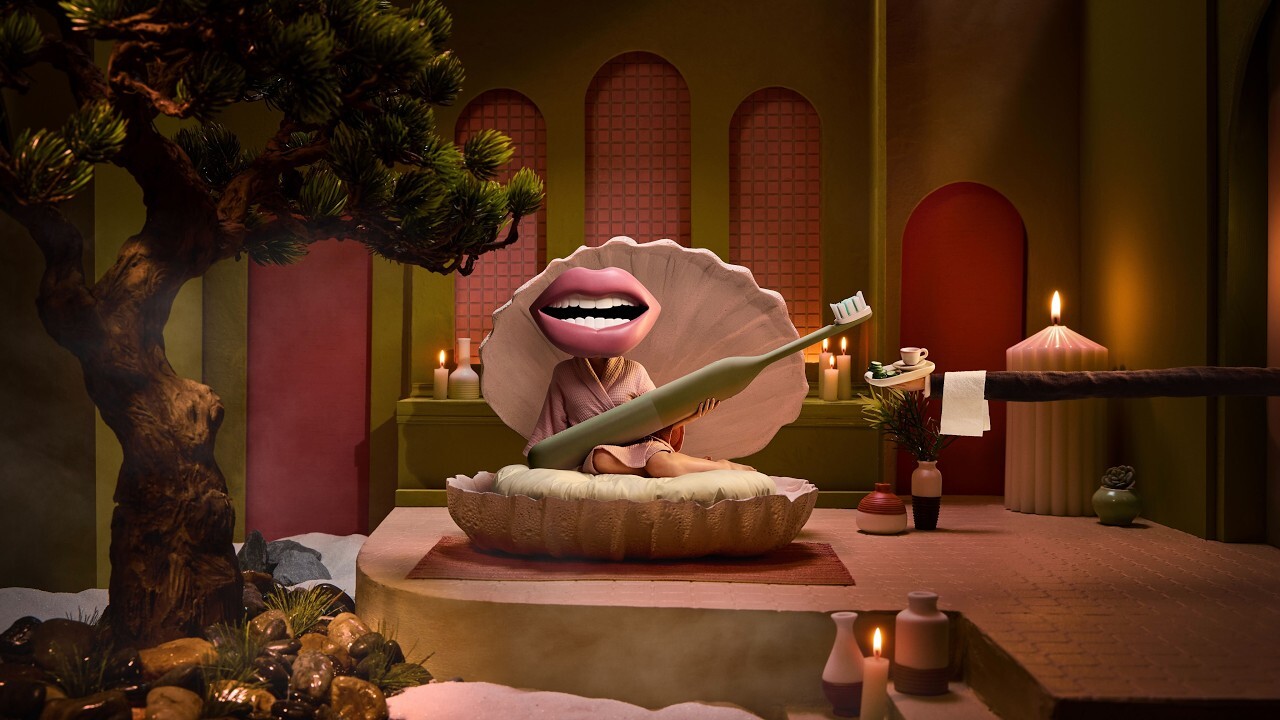
Quip's March spot is 15 seconds long. A human figure with a mouth for a head lounges in a spa on a shell-shaped daybed, holding a comically oversized toothbrush. It was made with a physical set, an actor in a custom mouth headpiece, miniatures for the exaggerated environments, and blue screen before compositing. The first comments read "this is AI" and "why are you using AI?" The behind-the-scenes was already planned; the team pulled it forward a month and captioned the Instagram post "No AI, just us."
LEGO's World Cup film puts Messi, Ronaldo, Mbappé and Vinícius Jr. on a spinning table as minifigures, each trying to plant himself on a brick-built trophy, and a child walks in and does it instead. The hashtag #HonestlyItsNotAI sat in the launch caption, and when Messi reposted the clip he kept the tag. His post was at 17 million likes and over 180 million views within a day.
Apple's holiday ad is woodland puppets carolling in a snow-covered forest. The behind-the-scenes showing every element, puppets and set, rendered with practical effects came out alongside it on day one, and the film has passed 15 million views on YouTube.
Judge the three on sequencing. LEGO and Apple shipped the behind-the-scenes as part of the launch, so the doubt and the answer arrived in the same scroll. Quip shipped it as a reply, and Quip had the harder creative problem, because a mouth-headed man on a daybed looks more like a prompt than a puppet does. The stranger the image, the faster the comments decide, so the strangest concept ships its footage first. Quip's footage was in the can and scheduled a month later than the comments needed it, and until it was pulled forward the frame around a 15-second ad was set by its own comment section.
Three jackets earned 186 pieces of coverage
KFC made three Pickle Puffer jackets for its Pickle Mania menu, one each for media, creators and fans, and those three objects returned 186 pieces of coverage, an estimated reach of 63 million and over 15 million social views. Per jacket, that is 62 placements and roughly 21 million people reached, on a production run of three.
KFC built the thing nobody had asked it to prove
KFC UK and Ireland ran this play in reverse, and it is the version I would copy. The object did the explaining. The team saw a generated video of a man handing sliced gherkins to strangers from a jacket filled with pickles and decided to build it for real.
The Pickle Puffer is a fully wearable jacket with a clear outer layer, real brine and sliced pickles under the surface, and a functioning straw so the wearer can drink it. It launched with the Pickle Mania menu, which carried Pickle Loaded Fries and Pickle Pepsi. "It's a bit unhinged, but that's the point," said brand manager James Channon, and the second half of his line is the brief: a wearable, drinkable tribute to the fans' obsession.
The three jackets were built with a specialist build partner and seeded to press, creators and fans, and the object does the job the second camera does on a shoot. A jacket you can watch someone sip from makes its own case, and the pickle drifting past the zip is the hand entering frame.
The part that transfers is the sourcing. KFC found a strange image in the generated slop stream, where thousands appear a day and die unseen, and picked the one with a physical build inside it. Then it made the build the headline, and the coverage was about the fact that somebody had actually done it, an angle closed to anyone who generates the jacket.
The preconditions. KFC had a fan obsession Channon could point at, a limited-time menu that needed a spike, and a brand whose tone can carry "unhinged" from a brand manager's mouth. A bank's brand manager says "playful" and the jacket dies in legal. The narrower part transfers anyway: when a category is drowning in generated novelty, a real one is cheap, and the whole build budget here was three jackets and a straw.
The making-of is a second ad, so buy it like one
The making-of has to be found by the same cold audience that found the hero, and on TikTok that audience is nearly all of it: in one example, 97.7% of a video's views came from people who did not follow the account and the Following feed delivered 0.1%.
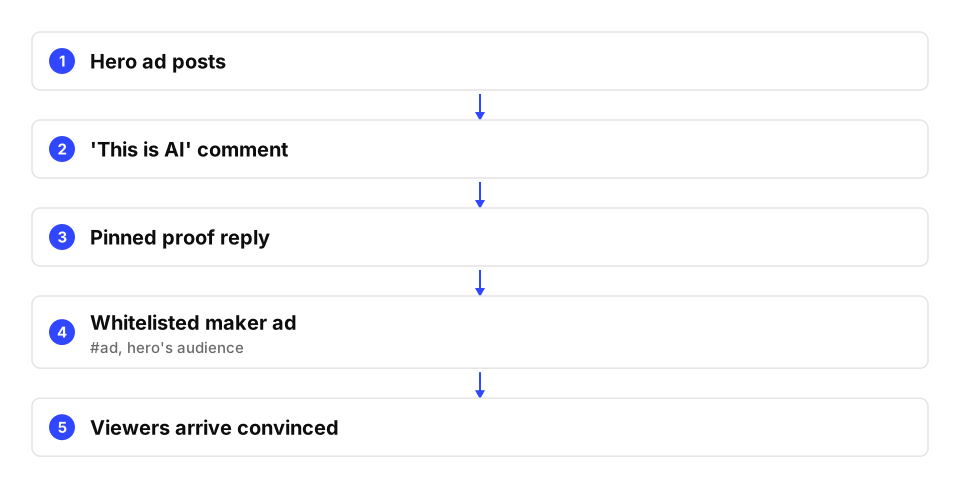
So we buy it like a second ad. It runs in its own adset against the hero's audience, on the same optimisation event, with its own budget line, and we read it on hook rate, 3-second plays over impressions, because stopping the thumb is the only job the cut has. The trailer version, tacked on the end of the hero, is where most making-ofs go to die, because it starts after the doubt has formed and the viewer has left. A cut that opens on the hand entering frame holds a cold viewer several times longer than the same footage left to ride as a trailer.
Whitelist the human. The puppeteer, the actor who wore the headpiece, the model-maker who glued the miniature: the behind-the-scenes should arrive from a person's handle, through creator-handle ads with their name on them, because the whole argument is that a person did this. That carries disclosure. In the US it is #ad, #sponsored, "Paid Partnership" or "Advertisement", unavoidable and placed before the content. In the UK the ASA has ruled #gifted inadequate and #aff insufficient. "Collab" and "partner" fail on both sides of the Atlantic, and since 2023 the FTC has gone after brands for failing to instruct their partners, so the label sits in the brief. The maximum civil penalty is $51,744 per violation.
Pin it. The first "this is AI" comment under the hero gets the making-of as its reply, pinned, inside the hour.
Disclosure runs the other way too. The honest brief for a campaign with a practical hero and AI-built variants is two labelled lines: the practical footage, and the generated resizes, each marked for what it is. Mixing them in one adset is how a brand ends up labelled AI on the one post it built by hand, and Reddit's 2026 policy now requires advertisers to flag ad images, video or copy that are substantially generated by AI.
Sign the file at capture or the label gets decided for you
Under the aesthetic there is now a file format, and it is the layer that outlasts the look. C2PA Content Credentials 2.3 covers live video for broadcast and streaming, with manifests now available in plain text, OGG audio and large AVI files, and a Conformance Program live since late 2025. More than 6,000 members and affiliates have Content Credentials in live applications.
The platforms read it, and they read it at upload. TikTok checks the C2PA metadata when a file lands and applies its AI label automatically: no review, no toggle, no expiry, and no re-evaluation if you edit the post or change the caption. Real footage exported from CapCut, Canva or Photoshop after a single AI-assisted edit inherits the marker and gets labelled like fully synthetic content, and one AI-touched image labels an entire carousel. CapCut is the single biggest false-positive source on the platform. Meta puts "AI info" front and centre on anything it reads as generated and tucks the same label into the post menu when the file was only edited.
Which means the behind-the-scenes cut can get labelled AI on its way out of the edit. That is the failure I would plan against this quarter, and the answer is to sign at capture and carry the signature through post. The bodies that sign at the sensor are the Leica M11-P, the Sony Alpha 1 II and Alpha 9 III, the Canon EOS R1 and Nikon's Z-series.
| Stage | What signs it | What strips it |
|---|---|---|
| Capture | A signing body such as the Leica M11-P, Sony Alpha 1 II or Canon EOS R1 | A phone; Android's implementation is forgeable with root access |
| Ingest | Card to ingest with the original file untouched | Re-encoding or format conversion on the way in |
| Grade and VFX | Tools that carry the manifest through; Photoshop has supported it since 2020 | One AI-assisted edit in CapCut, Canva or Photoshop adds an AI marker |
| Export and delivery | Export in the captured format with the manifest intact | Format conversion or cropping, which breaks the hard binding |
| Upload | Nothing reliable yet | Most social, messaging and CMS paths strip the manifest; TikTok reads and caches it first |
Be honest about what the signature proves. C2PA proves a signed claim arrived untouched, and leaves open whether the claim was true. A bad actor with a signing certificate can generate a deepfake, sign it as a camera capture and ship it with valid credentials. Nikon revoked the Z6III certificates days after its August 2025 firmware when a flaw let unauthentic images into a validly signed file. Google has marked the Android forgery report won't-fix. As of mid-2026 no dedicated camera has achieved compliance under the Conformance Program.
So the signed file is a defence against the automatic label and a record you can show when challenged. It is where the evidence lives once the raw aesthetic stops being readable, and the chain in the table has to exist before the shoot that needs it. Nobody goes back and signs last month's footage on a Leica M11-P.
Marketers already use AI for everything except the picture
| Task | |
|---|---|
| Admin | 57% |
| Copywriting | 54% |
| Analytics | 51% |
| Ideation | 46% |
| Personalise | 17% |
| Image/video | 15% |
| Service | 7% |
Do not label everything AI-free
Quip has no plans to label every campaign AI-free, and that is the right call. The policy is drawn around accuracy and around people, with everything else left open: AI stays out of the brushing demonstrations, where a wrong angle is a wrong instruction, and it cuts the ad versions and clears the repetitive work. That is the policy Quip put on record in March.
Sign a pledge that width and no wider. A blanket "no AI" pledge boxes a team out of the 20 to 30 deployable assets a single shoot should throw off, and somebody who never read it will break it by Q3. Aerie's October promise never to use generated bodies or people, and Heineken USA's line at creating a person who does not exist in real life, are both positions on people, narrow enough to leave resizing, versioning and background cleanup untouched. That is the width I would sign: people and demonstrations.
The strongest AI-made ads in the Ipsos test were product-driven, direct, and built on creative containers the brand had used for years, which puts the 30-second product spot in the one category where Sora 2 is already within seven points. That is the work to version by machine, and nobody in the comments is hunting its tell.
The hard part is deciding which concept will be doubted and what evidence survives a sceptical comment section, and it is a strategist's call made in the brief, before the deck. It is the piece of this a budget holder is actually deciding whether to staff. It takes a team about a year of launches to learn, because the only feedback is the comment section and it arrives one campaign at a time, which at a brand shipping one hero a quarter is four data points.
Rawness as an aesthetic has about a year left, and I will be held to that. The smear, the flash, the handheld wobble are already a style guide, and a style guide is a prompt; by this time next year generation will copy the messy sink convincingly enough that the look settles nothing. From then on the brief is provenance. The second camera stays, the signed file becomes the deliverable, and the question under the post becomes "show me the manifest."