
The brand website has stopped being the unit of AI visibility
An AI answer is assembled from passages, and each passage gets credited to the entity on the page. In 2026 that entity is a person more often than a company.
Across 1,856,259 social citations tracked over ten AI surfaces and 29 social domains between January and August 2026, social's share of citations rose from 4.9% to 7.2%. Owned content, the brand site and the blog on it, sat between 2.5% and 2.8% for the whole period. Earned sources, the news sites, review outlets and directories, take roughly 72%, and in consumer categories the expert review outlets outweigh user-review platforms by about 15 to 1.
Put those side by side and the blog budget looks wrong. The slice a brand controls directly is the smallest one, and it has not moved past 2.8% all year.
Roughly nine of every ten LinkedIn URLs the engines cite sit outside the company page. On ChatGPT, personal profiles and individual posts each take about a quarter of LinkedIn citations and the company page trails at 18%.
So the first decision I would take into a budget meeting is to move most of the content line from the corporate blog to long-form published under named people on the surfaces the engines already read, with the brand site kept for one technical job, which is anchoring those names.
Every named author gets an author page on the owned domain with Person schema, the same headshot and bio that appear on LinkedIn, and sameAs links to every profile they publish under. Organisation schema on the home page names those people. That join is what lets an engine attach a LinkedIn Article to the company without the company having written it.
The pages that stay get rebuilt for retrieval. Each section answers its own heading in the first 40 to 60 words, names its subject in full and stands on its own, because retrieval pulls passages one at a time with no memory of the paragraph above. We do that rebuild before the first LinkedIn Article goes out, in this order: the author pages, then the pages that already rank, then the rest, and nothing is published under a name until the author pages are live.
Long video gets cited fifty-one times for every Short
| Format | |
|---|---|
| YT Long | 574420 |
| LI Articles | 196628 |
| LI Posts | 34004 |
| TT Profiles | 33428 |
| YT Shorts | 11160 |
| TT Videos | 3640 |
Write the description as an abstract the engine can cite
The format ladder gives us a production spec, and we run it as a weekly loop.
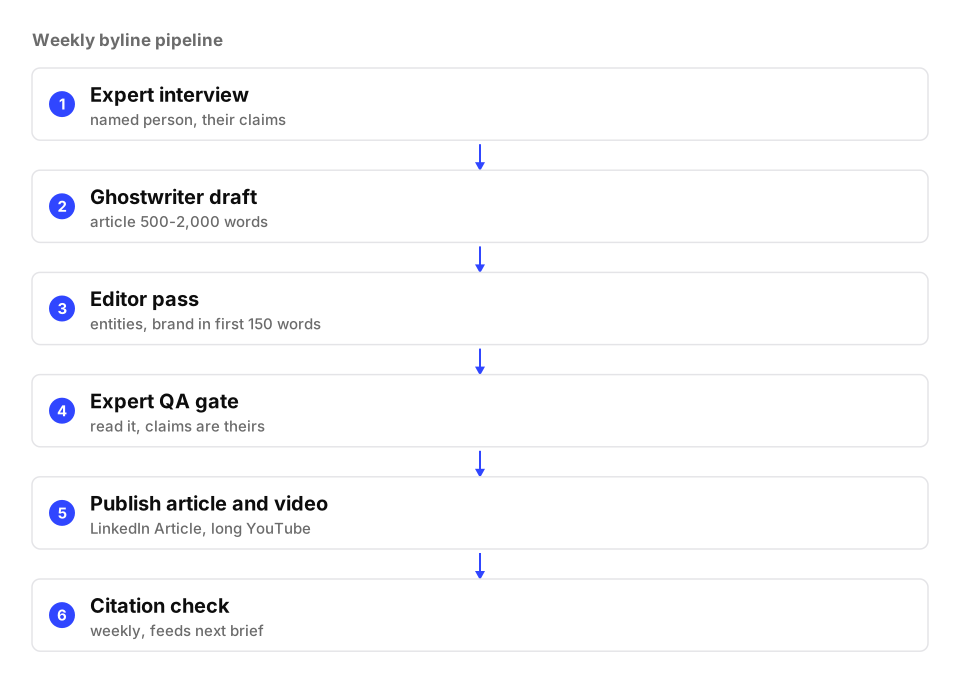
Long YouTube first. The engines read two things on a watch page, the description and the auto-generated transcript, so the description is written as an abstract: around two hundred words stating the question, the answer and the named products in it, with the brand and the category inside the first 150 words and chapters marked so each chapter reads as its own passage. Auto-captions mangle product names, and a mangled name is one the engine cannot join to the brand, so the transcript is corrected and re-uploaded the day the video goes up.
LinkedIn second. The Article is the citable object at 500 to 2,000 words, and the feed post is the distribution layer at 50 to 299 words, pointing at it. Original work takes about 95% of LinkedIn citations, so a reshare from the company page is wasted effort. Heavily cited text carries three to four times the entity density of ordinary English, which in practice means naming the product, the version, the competitor set and the person on every page, every time, and cutting the pronouns that stand in for them.
Structure third. Across sites, "best" roundups earn 7.06% of AI traffic, how-to guides 6.35% and "vs" comparisons 4.88%, so the piece is built in that shape: a comparison table, a numbered how-to, an FAQ block with the question as the heading. Only the first 30 passages of a page get embedded, so the answer sits at the top and the context underneath it.
Freshness fourth. Pages the engines cite are 25.7% fresher than what ranks in organic search, with a 13.1% preference for recently updated pages, so every piece gets a refresh slot in the calendar at 90 days where its numbers, its screenshots and its date stamp are replaced.
Then the gate. Before anything goes out under their name, the expert has read it in full, every claim in it is one they would make on a conference stage, and every entity has been checked against the product's current naming. The ghostwriter drafts it; the expert owns it, and nothing clears without their written sign-off in the thread. The cadence that clears that gate is one Article and three feed posts a week per named person, and one long video a week across the group, with the calendar written a month ahead.
Check the robots file first, and on TikTok only the bio counts
Whether a page can be read at all comes down to a robots file, and OpenAI and Anthropic each run three robots that do three different jobs.
| Robot | Lab | What it does | What disallowing it costs |
|---|---|---|---|
| ClaudeBot | Anthropic | Collects content that may contribute to training | Future material excluded from training datasets |
| Claude-User | Anthropic | Fetches a page when a user asks Claude a question | Content cannot be retrieved for user queries; visibility drops |
| Claude-SearchBot | Anthropic | Indexes content for search quality | Content is left out of search indexing; visibility and accuracy drop |
| GPTBot | OpenAI | Crawls for training only | Content excluded from foundation model training |
| OAI-SearchBot | OpenAI | Decides what appears in ChatGPT search | Site will be left out of ChatGPT search answers, around 24 hours after the change |
| ChatGPT-User | OpenAI | Visits a page on a user's request, no automatic crawl | Plays no part in search appearance |
Every setting is independent of the others, the rule has to be written per subdomain, and Anthropic honours a Crawl-delay line if load is the worry. The configuration we ship on an owned domain is simple: the search bots and the user agents are allowed everywhere, the training bots are a separate decision for legal to make, and nothing is blocked by IP because an IP block stops the bot reading the robots file it would otherwise obey.
The surfaces you publish on have made their own choices, and before we commit a named person's work to one we read its live robots file for the six agents above and log the result, then re-read it monthly because these files change. Facebook blocks Perplexity's bots entirely, so Facebook is a dead end for that engine whatever you post there.
TikTok is the odd one out. It reached 62% of Claude's social mix by mid-August 2026 and its pooled share roughly doubled over the study window, yet what gets cited is the account and almost never the video: 80% of TikTok citations point to profile pages, 33,428 against 3,640 for individual videos, and roughly three-quarters of them arrive through Google's two surfaces. The engine is reading a profile URL out of a search index, so the bio text is the only part of the account it can quote.
So TikTok is an existence signal. Each named person gets a profile there, a bio that spells out the brand, the category and their role in the same words as the author page, and a pinned link back to it. The content budget goes to YouTube and LinkedIn, whose watch pages and Articles the bots can open.
Each engine leans on one platform for most of what it cites
| AI engine | |
|---|---|
| Perplexity | 75% |
| Grok | 72.2% |
| DeepSeek | 64.1% |
| ChatGPT | 61.1% |
Sixteen sourcing changes in seven months, and five of them were reversals
Between January and August 2026 the models changed which social platforms they cite sixteen times, five of those changes reversed an earlier one, and most completed within one to three weeks.
The map as it stood in August. ChatGPT ran Reddit above 90% of its social citations from April into early August, then in a single two-week stretch Reddit fell from 8.0% to 2.9% of its total citations and the mix settled at Reddit 77%, TikTok 14%, YouTube 4%. LinkedIn rose from about 8% of pooled social citations to roughly a fifth in three months, lifted by Perplexity, Meta AI, DeepSeek and Copilot. Perplexity tested four platforms in June and kept one, LinkedIn, now about a third of its social citations. Gemini added Facebook for the first time in August and had it at 13% within weeks. YouTube narrowed from about 43% to about 37% of pooled citations as the models diversified, and Reddit held near 30% all summer while hiding more changes than any other platform.
Claude flipped, and the dates do not fit the obvious story. From August to mid-December 2025 Reddit was Claude's largest social source at 42.4%, and that window sits after Reddit filed against Anthropic on 4 June 2025. Only in the January to August 2026 window does Claude's Reddit go to effectively zero, with TikTok rising from single digits to 62%, so the cut came at least seven months after the complaint and nothing public explains the gap.
Perplexity is the documented policy cut. After Reddit sued it on 22 October 2025, Reddit's share of Perplexity's social citations dropped from 19.5% to 2.67% and YouTube's jumped from 51.98% to 95.25% in the same window, which is the over-indexing showing: one platform went from half of Perplexity's social citations to nineteen in twenty.
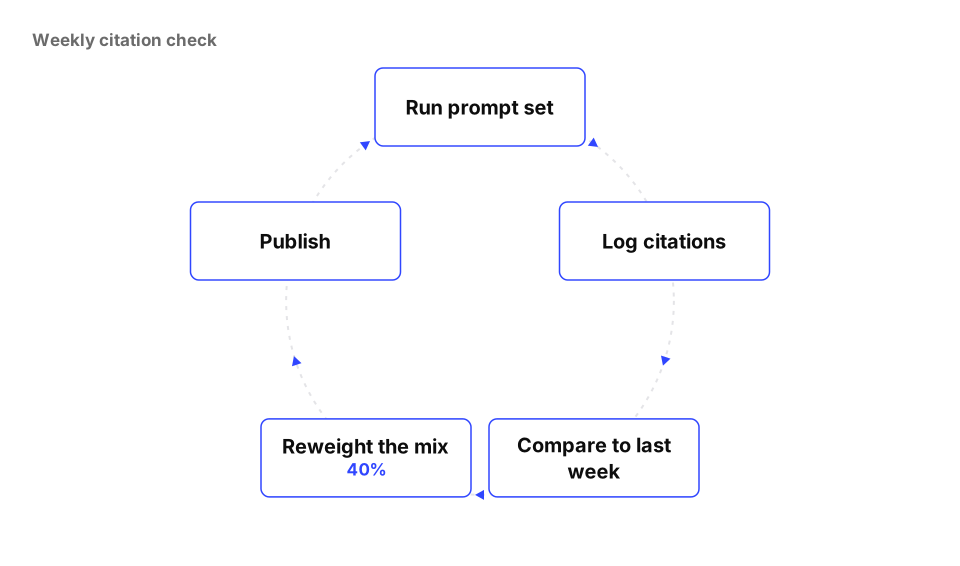
A monthly review misreads all of this. A change that completes in two weeks shows up in a monthly cut as a dip that may already have reversed, and the team ships a plan against a map that has been redrawn twice. So we run a weekly per-model citation check: the same prompt set, forty to sixty prompts across the category's buying questions, run on each engine, with the cited domain and the URL type logged against the week. Four weeks of that is enough to see a change land, because most of them complete inside three.
The allocation rule that follows is a cap. No single platform carries more than roughly 40% of the social effort, however well it is performing this month, because the one that is winning is the one with the furthest to fall.
Measure it on signups, because the sessions are a rounding error
AI platforms sent 0.32% of all website traffic across 101,574 sites between January 2025 and April 2026, up from 0.24% the year before and 0.02% the year before that. A session count built on that base will never clear a budget review, so sessions is the wrong KPI from the first week. Google still sends 134 times more visitors, and ChatGPT alone is 74.78% of what the engines do send.
The plumbing has to be right anyway, because the number that does pay is downstream of it.
| Plumbing | Setting | Where it leaks | What we do about it |
|---|---|---|---|
| GA4 AI Assistant channel | Broadly available across properties from 7 June 2026 | Google does not publish the referrer list it matches | Keep a custom channel alongside it and reconcile the two monthly |
| Custom sessionSource regex | chatgpt.com, perplexity.ai, claude.ai, gemini.google.com, copilot.microsoft.com, deepseek.com, grok.com, meta.ai, you.com | New engines appear faster than the list is updated | Review the pattern against raw sessionSource values each quarter |
| Referrer header | Passed by the web interfaces | 35% to 70% of AI sessions arrive with no referrer and land in Direct; ChatGPT's mobile app strips it and appends utm_source=chatgpt.com only sometimes | Add a self-reported source field at signup with the engines listed by name |
| Google AI Overviews and AI Mode | Counted as google / organic | No native way to split them from a conventional search click | Treat Google organic as a blended line and read the citation log instead |
The self-reported field recovers most of what Direct swallowed. A single select on the signup form, "Where did you hear about us", with ChatGPT, Claude, Gemini, Perplexity and Copilot as options, is answered at the one moment the person remembers. We put it on every form we build now and read it against the referrer-based channel to size the leak.
Then the KPI. AI visitors convert at a multiple of organic that runs well into double digits for software. In March 2026 one SEO software company credited Claude with more new signups than ChatGPT, despite Claude sending a fraction of the visitors. The report I would ask for before month twelve has three lines: signups attributed to each engine from the self-reported field, cited URLs per engine from the weekly check, and the share of all signups that named one.
Half a percent of visitors, twelve percent of signups
One SEO software company's own March 2026 reporting: the engines sent one visitor in two hundred, and those visitors produced roughly one signup in eight. A channel that small on sessions and that large on signups is one the traffic report hides, which is why the signup field and the weekly citation log come first and the session count comes last. Priced against the 12.1%, three to five named writers and the loop behind them are cheap.
Three to five named people, a ghostwriter and editor loop, and twelve months
- Three to five credible named humans with a public bio, a consistent headshot and an author page on the owned domain. They already have a reputation in the category; the programme borrows it.
- One ghostwriter and one editor running the weekly loop, interviewing each expert for forty minutes, drafting from the recording, and returning the draft for sign-off.
- One long-form video producer for the YouTube channel, owning the description, the chapters and the transcript clean-up.
- The experts' own time at the QA gate, roughly an hour a week each, and that hour is the one that gets skipped first if nobody protects it.
Twelve months is the honest horizon. The median Reddit thread cited by ChatGPT is about a year old, and durable cited pages behave differently from the ones that appear once: a small fraction of pages that keep being cited across months carry most of the citations, while a page cited once is usually finished. The programme is building that small durable set, and a page has to sit on a stable URL through several sourcing changes before you know whether it is in it, which at this year's pace of change is three months at minimum and more often two quarters.
Substack shipped Pangram scanning on 21 July 2026, on every post, Note and comment over 100 words, on web, iOS and Android, and the reader runs it before deciding whether to trust the writer. Substack's own name for the mismatch is Claudefishing, and it is the argument writers have been having all summer. The reader who runs it on Substack today is the same reader on LinkedIn tomorrow, and a piece under a real name that was manufactured from a prompt fails in front of the exact person it was written to persuade. A creator who disables the scan invites the question of what is being withheld, structured and technical writing can be flagged incorrectly, and the tool cannot see whether a human cared, only the pattern of the prose.
So the ghostwriter's job is transcription with structure. The expert's words, from the recording, in the expert's sentence shapes, with their own examples and their own hedges left in, arranged under the headings the retrieval layer needs. A ghostwriter who writes what the expert might have said has produced a page the reader can now test and the expert cannot defend.
Costed as headcount, that is two to three full-time writing and production roles plus a protected hour from each of three to five senior people for a year before the signup line moves.